Tuesday, 11 June 2024

Hackathon in Edinburgh

 I had an early start today (alarm set for 4:10 am) for a three-day trip to Edinburgh, where I'm attending a hackathon with my colleagues Abhishek and Grant.  The idea is that there will be some experts here in the latest coding technologies for running codes on the latest GPU hardware, and they will help us transfer our CPU-based code to GPU where it should be able to run much faster, enabling us to tackle physics cases that are currently too hard for us. 

So far, it has been going okay - some steps forward and some technical issues holding us back, but we're only half way through the first day of three.

Edinburgh is a pretty city and if I had taken a photos I could include them here.  I haven't (yet), so instead, here is the tweet from the DiRAC_HPC Twitter account, which features our team in the foreground table.  You can see Grant and Abhishek and a tiny bit of me at the right of the picture


Friday, 3 May 2024

Open Access in Nuclear Physics

 Thanks to the trawling majesty of Google Scholar, I came across a paper published in the Ukrainian journal Nuclear Physics and Atomic Energy which cites a paper of mine.  The article itself presents some nice calculations of giant resonances in tin nuclei.  Though I have been aware of this somewhat obscure journal before, I hadn't quite realised that it is free to publish in and open access.  It is listed in the Directory of Open Access Journals, pointing out that not only is it free to publish in, but authors retain full rights, and the papers are published as CC BY-NC license.  So, all in all, it ticks all the boxes.  I must say, I also like its basic html feel and the idea of supporting a journal published by the Ukrainian nuclear physics community is also appealing.  

The only weird thing about it is that submissions must come with a cover letter signed by your Head of Department. Oh, and the papers must be written in Microsoft Word, which is also a bit of a weird requirement.


Tuesday, 30 April 2024

Th-229 isomer breakthrough

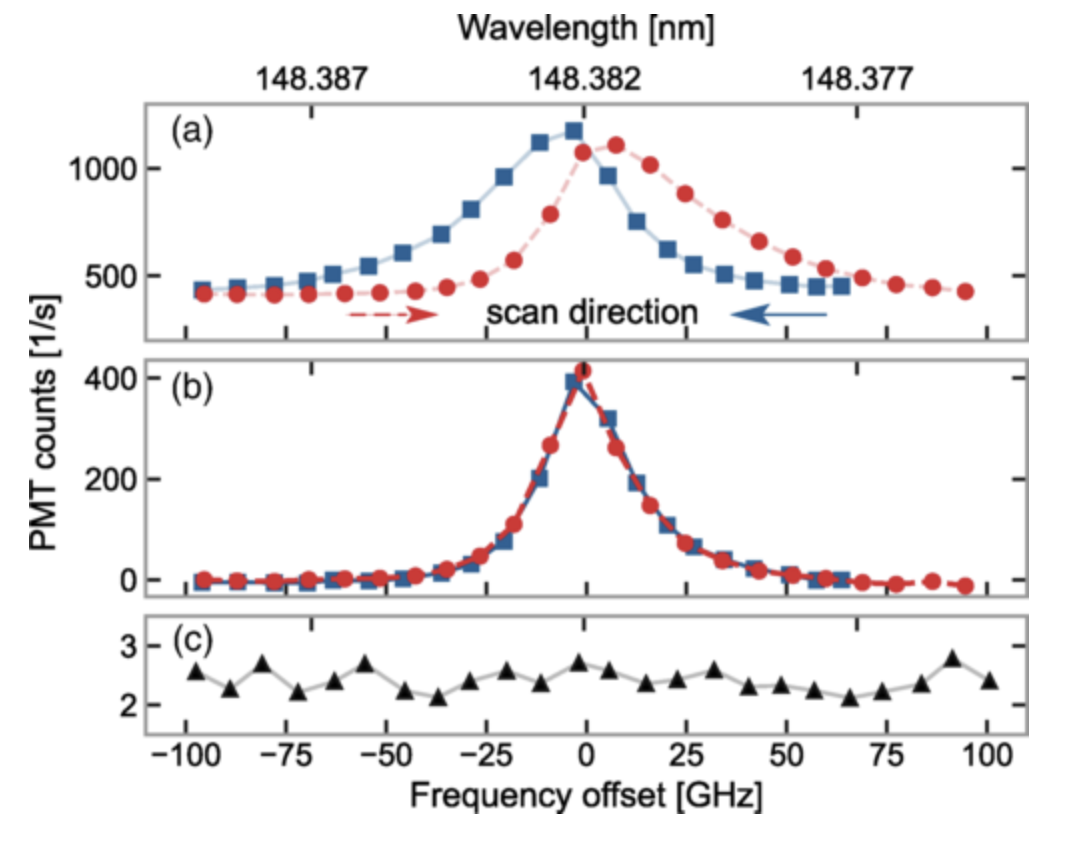
 A group in Germany has just published a paper showing a huge improvement in accuracy in measuring the energy and lifetime of the lowest-lying nuclear excited state that we know about - the 8.4 eV isomeric in Th-229.  While typical nuclear excitation energies are around one million electron-volts (1 MeV),  the relatively tiny energy of the thorium isomer puts it in the kind of energy range that can be manipulated by optical equipment.  In the case of the published work, the authors developed a bespoke ultraviolet laser that was able to sweep the right candidate frequencies to pin down the isomer energy to an accuracy of nearly 1000 times better then the previously best measurement.  

This isomer is not just a quirky curiosity:  A long-lived low-energy state in a nucleus, which is much better isolated from environmental effects than an electron in an atom or molecule, has the possibility of being used in applications such as a nuclear clock, potentially surpassing atomic clock timekeeping, as well as other possible quantum technology applications such as qubits for a quantum computer, or a quantum sensor to test fundamental physics. 

Plot from the (Creative Commons open access) paper below showing the resonant peak in the frequency scan:


Thursday, 25 April 2024

16 year erratum

 There is an erratum published in Physical Review C this week which corrects paper from 16 years ago.  In their opening sentence they own up to adjusting the data in a way they shouldn't have:

In our original publication of level scheme of 104Nb, we determined level energies based on certain transitions and subsequently adjusted the raw data for other transitions to fit these energies. This is not correct scientific procedure as it alters original data, and it risks introducing incorrect transition and level energies into the literature. The main purpose of this erratum is to provide the original data.

and go on at the end to 

thank the Physical Review C editors and the data scientists at the National Nuclear Data Center at BNL for calling our attention to these corrections

To me, this shows that processes are working and that the data from their paper, which made its way into databases, was found to be erroneous, the error investigated, and corrected.  Too bad it happened in the first place, but the data remained available for scrutiny and the scrutiny worked.


Tuesday, 16 April 2024

IoP conference at Liverpool

 It's my first day back at work since being at the IoP HEPP/AP/NP (that's High Energy & Particle Physics / Astroparticle Physics / Nuclear Physics) combined conference.  I was there, talking in the plenary session about quantum computing for nuclear structure, and a lot of Surrey postdocs and students also gave talks and posters.  

Here is a selection of photos from the conference:

My student Sam Sullivan presenting his poster

My student Grant Close presenting his poster

Me giving my talk

My postdoc Bharti giving her talk

My student Isaac giving his talk

The sky looked pretty as I walked to the conference dinner

Conference dinner!

As well as these photos, I had to take one video, as my postdoc Abhishek is a master of making animations, and so a static photo would not have done is presentation justice:


Tuesday, 26 March 2024

New isotopes project website

For some years Michael Thoennessen at Michigan State University has developed and curated a database of isotope discovery - i.e. when, where, how and by whom was each isotope of each element discovered.   He has just emailed out about a revamp of the website with new design and new features. The site is here. 

 One of the new features (at least, I think this is new) is that you can search discoveries on various fields.  I tried searching for my name ("P. D. Stevenson") and lo and behold you can find the four isotopes that I "helped" discover.  By helped, I mean I was coauthor on the discovery paper, as I contributed to the theoretical analysis.  I didn't set foot in the lab where the experiment actually took place.

Here is the copy-and-paste of the results table:

Search results:found 4 isotopes

In the table below click on an isotope symbol for more information about its discovery. When quoting the abstracts please cite the abstract as: “FRIB Nuclear Data Group, Discovery of Nuclides Project, https://doi.org/10.11578/frib/2279152”.
Newly discovered isotopes will be included after the references are entered in the NSR database.
IsotopeFirst AuthorLabCountryYearReference
155TaR. D. PageJyväskyläFinland20072007PA27
157WL. BiancoJyväskyläFinland20102010BI03
159ReD. T. JossJyväskyläFinland20062006JO10
161OsL. BiancoJyväskyläFinland20102010BI03


Tuesday, 19 March 2024

Bye bye 12BB03

 Last week I was on a work trip to the USA and on my first day there I got an email from my employer telling me that I have to move offices and I should come and get the key of my newly assigned office.  It came a bit out of the blue and now that I'm back I find some of my colleagues have already moved and I have started the process of clearing out my office.  I'm using the opportunity to get rid of some of the stuff I have accumulated over the 20 years or so I have been in here.  It's a long time in anyone's life, and longer really than almost any other constant in my life - from children to partners to where I live, I'm in a different situation than I was 20 years ago.  In some sense I'm saying goodbye to the longest-lived part of my life that I saw on a near-daily basis.  On the other hand, it's only a room, and my employers can reasonably ask me to move to another room. 

Here are some of the things I have come across and thrown away:

My stash of used train tickets that I kept for no good reason.
Many memories (good and bad) evoked from looking at the journeys.

Once upon a time I used paper diaries from the Institute of Physics
to plan my (work)life.  Here is the week in 2003 where there was going to
be a retirement dinner for Prof Ron Johnson.  I suppose it was moved(?) so
I crossed it out.

I have a bunch of Open University material donated
to me by someone I used to tutor.  After he got his degree
he didn't want to keep the material and I have kept it all in a box
ever since.