Showing posts with label publishing. Show all posts

Tuesday, 30 June 2020

Nuclear soliton review

The latest article in the special topic I am co-editing in Frontiers in Physics appeared today.  It is called "Solitons in Nuclear Time-Dependent Density Functional Theory" and is by Yoritaka Iwata, from Kansei University, Osaka.

It follows on from some of his previous work (including a paper in New Journal of Physics I co-authored with him), combining a review of why one might expect soliton behaviour in nuclei, some existing results, and a new more thorough exploration of relevant parameter space.

The basis of the idea is that the time-dependent density functional theory which describes nuclear systems appears as a non-linear Schrödinger equation which formally is equivalent to the canonical equation with which solitons are described.  Depending, then, on details of the nuclear interaction, and on the boundary conditions – the specific nuclear interaction being explored – one may find soliton solutions.

One particular confounding factor with the existence of solitons in nuclear reactions is the relative speed of the waves which equilibrate the charge and those which move matter.  If neutrons and protons are exchanged too quickly in reactions, then solitons are not possible.  This is something highlighted in Iwata's previous papers, and a hot topic in understanding heavy-ion reactions, with a recent paper in Physical Review Letters studying the same thing from a more nuclear physics (rather than mathematical/solitonic) perspective. 

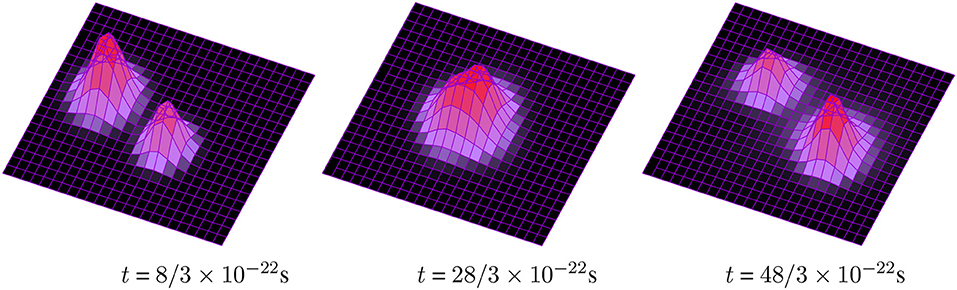
Here's a picture from the paper (their Figure 4) showing a collisions around the boundary where charge equilibration is important:

Friday, 28 February 2020

Next papers in our Frontiers In Physics Special Topic

I posted earlier in the month about the first papers to appear in the special topic on time-dependent methods in nuclear physics in Frontiers in Physics that I am co-editing with some colleagues.  Here are a summary of the next four, which have all appeared since then:


Far Off Equilibrium Dynamics in Clusters and Molecules (doi: 10.3389/fphy.2020.00027) by Phuong Mai Dinh, Marc Vincendon, Jordan Heraud, Eric Suraud, and Paul-Gerhard Reinhard, describes techniques and results from non-nuclear systems such as small metal clusters, atoms, and molecules.  The techniques are compared with analagous methods in nuclear physics, and the differences discussed, such as the need to deal with electron emission, and the interaction with laser fields, as well as the different interactions involved in the density functionals.  The plot shown here (from Fig 1 in the paper) shows the response in the dipole moment of a cluster of five sodium atoms to an excitation by a laser pulse.  The excitation and deexcitation is seen over a period of about 20 fs (though I dare say the compitational simulation takes some orders of magnitude to reproduce what nature does in real time).

Predictions of New Neutron-Rich Isotopes at N=126 in the Multinucleon Transfer Reaction 136Xe + 194Ir (doi:10.3389/fphy.2020.00038) by Xiang Jiang and Nan Wang uses the time-dependent Hartree-Fock method to provide a microscopic description of nuclear reactions of the xenon and iridium isotopes mentioned in the title, to look at some non-central reactions in which the reacting nuclei transfer some neutrons form one of the nuclei to the other during their reaction time, and then are left in excited states of another pair of isotopes following the transfer of neutrons.  A semiclassical approach (the GRAZING model) is then used to give a statistical de-excitation of the excited fragments to see what final set of isotopes are likely.  The purpose is to see if this kind of reaction can be used to study as-yet-unseen isotopes in current experimental facilities.  The results are that the proposed reaction should have a cross section large enough to produce new isotopes in presently feasible reactions, for isotopes around N=126 and Z~74.  The figure shows snapshots of the time-dependent part of the simulation of the two reacting xenon and iridium nuclei.
Quasifission Dynamics in Microscopic Theories (doi:10.3389/fphy.2020.00040) by Kyle Godbey and A. S. Umar discusses the microscopic picture of what happens when you try to make the kind of fusion reactions to discover new superheavy nuclei.  The two nuclei you are trying to fuse together might, depending on the exact details of how they impact on each other, might briefly fuse before falling apart again ("fusion-fission") or they might graze each other with the transfer of a few nucleons (neutrons, mainly - the mechanism discussed in the paper above by Xiang Jiang and Nan
Wang) or they might stick together without really fusing to an equilibriated compound nucleus and split apart into two fission fragments from a kind of molecular state.  This is quasifission and is discussed here for the purposes of understanding it as a kind of hindrance to forming new superheavy nuclei.  The authors show how to identify quasifission in mass-angle distribution measurements and map out the landscape of the briefly-made (super)heavy system, as shown in the figure showing how the entrance and exit channels are constituted in terms of the shapes of the combined system.

Fusion Dynamics of Low-Energy Heavy-Ion Collisions for Production of Superheavy Nuclei (doi: 10.3389/fphy.2020.00014) by Xiao Jun Bao is a mini-review surveying the literature for the various components of the mechanisms by which superheavy nuclei are formed, or fail to form (such as by the quasifission process discussed above by Godbey and Umar).  Aside from covering a broad survey of different theoretical methods, the paper highlights the uncertainty in the probability for a reaction to form a compound nucleus - an excited nucleus made from the colliding fragments which has lost the memory of what the intial fragments were.  That uncertainty, then, points to the need for more work in this area.  There is one figure in the paper, which neatly shows the possible reactions mechanisms for two colliding heavy nuclei.


Thursday, 27 June 2019

Publishing proceedings in SciPost

In September, we (the Surrey nuclear theory group) are hosting the 24th European Few-Body Physics Conference.  One of my main roles on the local organising committee is to arrange publication of the proceedings, and I'm pleased to have organised this with the journal SciPost Proceedings.  Unlike most (all?) of the other regular journal options, SciPost proceedings are free to publish in and free to read.  The costs involved in the whole publication process are pretty modest, being the web–hosting of the papers, and the provision of a doi for each paper.  All other tasks, such as managing and implementing the refereeing and editing process is done, as usual, free of charge by academics, who are paid a full time salary to be academics. 

Those low costs of running the journal are provided by sponsors, and I'm happy to see, from attending a presentation about Plan S last week, that the University of Surrey are sponsoring SciPost.  The amount paid by the University is minuscule compared to traditional journal subscription costs, and amounts to the cost of paying for a couple of Article Processing Charges to a regular journal.

I'm excited to go through the process of editing the proceedings (i say now, before the real work starts in earnest), and I'll report back here how it goes later in the year.

Monday, 29 October 2018

Puns in author lists

A tweet, below, that I saw yesterday asks (jokingly, I assume) for potential scientific collaborators just to make amusing author lists:
There is already a famous example in nuclear (astro-)physics: The Alpher, Bethe, Gamow paper whose author list was partly contrived to make a play on the first three letters of the Greek alphabet.

With my surname (Stevenson) I don't see much scope for good co-authorship puns.  Perhaps I should marry my partner, and take her surname, Fox.  Then I can collaborate with a Hunt, Hunter, Cub or Trot (if those are even names), or perhaps just changed my title to "Fantastic Mr".

Readers, are you aware of any other such punning author lists, or have any aspirations of your own?

Wednesday, 10 October 2018

A journal from Croydon


Croydon, erstwhile part of Surrey (until 1965), is a place subject to much comedy at its expense.  Mind you, this is true of Surrey in general, which is England's archetype of a Home County.  Any comedy writer wishing to evoke a sense of smug  conservative, curtain-twitching, self-satisfied middle-Englandness, or just plain suburban mundanity need look no further than the county of Surrey.  Where else would the Durselys live in the Harry Potter series?  Where would Ford Prefect claim to have come from as cover in The Hitchhikers' Guide to the Galaxy?  Where would Tom and Barbara Good play out their dreams of self-sufficiency, outraging their neighbours' sense of propriety in The Good Life, if not in Surrey?  

I think Croydon is a fine place.  One thing that I didn't know about it until today is that it once had a Natural History and Scientific Society.  It was in existence around 100 years ago, when the terms Natural History and Science had about equal currency.  I found it out because I came across a reference to a paper published in its Proceedings:


Now I want to publish all my papers there, but I rather suspect the journal is defunct.  Presumably I would have to go and read my papers to the society first before publication.  

In the source I found this reference from (annual report of the British Association for the Advancement of Science, 1910) there are a bunch of neat parochial journals cited: Bradford Scientific Journal, Report Royal Cornwall Poly. Soc., Report Ealing Sci. Mic. Soc., Journal of Ipswich and District Field Club.  All, I suppose, have ceased publishing.

The picture at the top is of passengers waiting at East Croydon station.

edit: I'm quite wrong about the Croydon Society being defunct.  Not only does it still exist, but it still publishes proceedings: https://cnhss.co.uk/booksproceedings/