Tuesday, 11 August 2015

Relativistic bias

As it's summer, I find I have the time more often to just browse recent results in nuclear physics.  One way of doing this is to go to the Physics Review Letters (PRL) website, and look at all the recent papers in the Nuclear Physics section.

If I do this, I see many interesting papers;  Some recent Earth-based determinations of reaction rates for nuclear reactions that take place in stars and which are important in understanding stellar evolution;  Some neat calculations of how nuclei can stretch into rod shapes as they rotate very fast;  The observation of a new and really exotic nucleus -- an isotope of hyper-hydrogen;  a new "soft" excitation mode in Lithium-11, itself a really interesting nucleus which is as large as a nucleus of lead despite having around 200 fewer nucleons in it.

What struck me most immediately about the list is that there were three papers among the 25 on the list that were "Editors' Suggestions" and that they were all from the sub-field of relativistic heavy-ion collisions.  Editors' Suggestions are exactly what the name suggests, and they get promoted within the Physical Review Letters website, appearing in the Highlights section.   From looking at the papers involved, I find it hard to conclude anything but that the editors involved in the relativistic heavy-ion papers are more active and zealous in promoting papers in their area than editors involved in the rest of nuclear physics.  I realise PRL has a history of publishing quite a high proportion of relativistic heavy-ion collision papers compared with other nuclear physics journals, perhaps thanks to its geographical ties to Brookhaven Lab, but I had not quite realised the obvious editorial differences between the sub-fields.

Anyway, attached to this plot is a pretty picture of some stretched-out Carbon isotopes from the preprint version of the rod-shaped nucleus paper mentioned above.

Sunday, 9 August 2015

The annual increment

It was my birthday yesterday. I turned 29 years old.  In hexadecimal, at least.  My birthday always seems to have a habit of occurring right in the middle of summer.  I guess it's good in that it meant I never had to go to school on my birthday, but was probably bad for my mum who had to be in the late stages of pregnancy in the hottest days of the year.  Mind you, in Glasgow, maybe it doesn't matter too much.

England regained the Ashes on my birthday, which was nice.  The football season started, too.  My team -- Ipswich -- managed to get to 90 minutes with a 2-0 lead then end up drawing 2-2.  May as well get used to the way things will go for the next season, I guess.  As I mentioned in my previous post, as I've grown up, I've been used to having the news talk about the anniversary of the dropping of the nuclear bombs in World War 2 bracketing my birthday.  The second one took place today, on 9th Aug, in 1945.  It's this arbitrary temporal coincidence which prompted an editor from The Conversation to ask me if I would write something about nuclear physics.  It's here.

Thursday, 6 August 2015

70 years since Hiroshima

Today, the 6th of August 2015, marks 70 years since the first atomic bomb was used in anger.  I'm not much of an historian of nuclear physics, though I can surely see that the use of atomic weapons was as much an irreversibly terrible act by humanity as any other.  

If you want to follow more about the history of nuclear weapons, then my go-to person on the internet for all things nuclear-weapon related is Alex Wellerstein.  Follow him on twitter: @wellerstein or follow his blog.

Even before I was a nuclear physicist, I'd noted that my birthday (on 8th August) falls between the two days when the bombs fell on Hiroshima (6th Aug) and Nagasaki (9th Aug).  Always around my birthday during my life have there been news stories about the bombs.  The biggest event, though, on the actual day of my birth, in 1974, was Richard Nixon's resignation.

Sunday, 26 July 2015

ils ne regrettent rien

I wonder if regular readers of this blog (Hi Kelly, Arron), have ever noticed the similarity (as pointed out by Arnau Rios) between Prof Wilton Catford of the University of Surrey and Aristide Bruant, the erstwhile French cabaret singer and nightclub owner, famed for his portrayal by Toulouse-Lautrec

Bruant
Catford

Tuesday, 21 July 2015

UK academic job

Dear readers interested in a job in experimental nuclear physics,

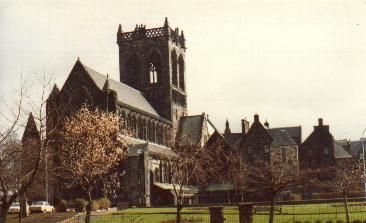
The University of the West of Scotland (UWS) has a position open for a lectureship in their experimental nuclear physics group.  The research part of the job should bear a relation to the new SCAPA accelerator facility at Strathclyde University, of which the group at UWS is a collaborating member.  The job is based in Paisley, Scotland.  The picture attached to this post is Paisley Abbey, situated in the centre of the town.  Details of the job are found on the UWS website, in the jobs section. 

Saturday, 18 July 2015

A week in Dubna

I have been spending this week at a conference in Dubna, Russia.  The town was build immediately after the Second World War for the Soviet nuclear research programme, and is the home of Russia's main facility for basic nuclear physics research (as opposed to weapons research, which took place in a number of cities which are still closed).

Perhaps it is most famous for the discovery of some of the superheavy elements -- those elements in the periodic table that are too short-lived to be found naturally-occurring on Earth, but which can, and have been, created in the laboratory. 

The picture attached to this post if a statue of Georgy Flerov, and in the plaque you can see the symbol Fl and the atomic number 114, since Flerovium was named in his honour.  Dubnium is element 105.

I must confess, I was kind of expecting Dubna to be an ugly place,  It was built for a specific purpose in Stalin's time and I expected it to be pretty utilitarian, and not pretty.  Actually, it's a rather attractive place (at least the bit where I am staying), with nice buildings, the Volga cutting through the town, and the forest, which was not cleared when building the town, resulting in trees disturbing practically every pavement.

Wednesday, 15 July 2015

Two margarines

I wonder if readers of this blog (hi Mum) have previously noticed the similarity in appearance between Professor Vadim Soloviev, erstwhile physicist from Dubna, and John Shuttleworth, Sheffield's most famous son?

Shuttleworth
Soloviev