Tuesday, 14 July 2015

A pairing of physicists

I wonder if readers have previously noticed the similarity between Nikolay Bogolyubov, lately of the Joint Institute of Nuclear Research, Dubna, and Chris Hooley, extant physicist at St Andrews?


Bogolyubov
Hooley

Wednesday, 8 July 2015

Results Day

Today is the day that the University gives the final degree results to students.  There will be some very happy students, and some not so happy.  From Facebook, I've seen mostly the happy comments from students who have done very well.

I'd like to offer my congratulations to all those physics students who will be graduating at the ceremony next week.  Unusually, I won't be attending this year, as I'll be away at a conference.  I'm particularly pleased that all my personal tutees have done well, and it's too bad that I won't see them next week.

When I was an undergraduate (at Oxford), the final exam results were posted on a bit of paper outside the Examination Schools -- a building on the High Street.  The results are they for everyone to see.  We had some guidance as to when the results would be out, but I seem to recall it was delayed for a day or two.  I remember asking one of the physics tutors at my college if there was any news about the results on the day that they were supposed to be out.  He told me that there was going to be a delay of a day or two.  He then added with a smile and a wink that I didn't need to be too worried about the results.

Wednesday, 1 July 2015

Summer and Units

It's a hot day in the vicinity of the University of Surrey, today.  According to the BBC News website, the temperature at Heathrow airport, around 20 miles away, is 35ÂșC.   The headline figures on the BBC website seem to be given in degrees Celsius, though I realise that this is user-settable, and I may just have set it in the past.  It does seem the norm now, in the UK, for temperatures to be given in degrees Celsius.  The newspaper closest to hand (an Independent on Sunday from a few weeks ago) also gave degrees Celsius on their map, and only give Fahrenheit temperatures in brackets on the longer lists of temperatures.

It was not always so, of course.  In my medium-length lifetime (I'm the UK's median age), temperatures have switched, weights of groceries have switched from pounds and ounces to kilograms, petrol is now dispensed in litres, not gallons, though we still measure road distances in miles, and buy beer and milk in pints.  I think people's heights are by now pretty widely dual use in terms of metres vs feet and people's weight similarly has both stones and kilograms widely in use in the UK.

I am not terribly young, but my entire school education has been using metric units for all practical purposes.  Anyone else my age or younger ought to find metric units a breeze, so when there was a story on the Radio 4 Today program the other day about a particularly heavy baby, with the weight only given in lb/oz, I tweeted, a bit tongue in cheek:
The main responses I got were along the lines that no-one the responder knows ever quotes baby weights in kilos.  That's quite curious.  Even when I was born, the record from the hospital given to my parents lists my weight in kilos.  Likewise for my two kids, and I certainly only remember their weight in kilos.


Friday, 26 June 2015

Performance Analysis Workshop

We're by a weir on the Wear
Today and yesterday, I've been attending a Performance Analysis Workshop.  This is not a training course designed to help me conduct staff appraisals, but a computational workshop teaching me how to use some tools to analyse if my codes are running efficiently when I put them on big machines and run them in parallel mode, using many processors at the same time to share the work.

The course appealed to me as it included plenty of time in it to do some hands–on work actually at the workshop, with the help of the course presenters, and tutors, into analysing my own code.  That's been really useful, whereas I think if I attended, learned some rather abstract things (or looked at some pre-set simple examples of codes) then went away and tried it with my code, it would not have worked so well.

The workshop is taking place in Durham.  Also taking place in Durham today and yesterday are graduation ceremonies, which helps explain why the closest hotel room I could get for this trip is in Newcastle.


Wednesday, 24 June 2015

Haway the lads

I'm in Newcastle.  I think it's the first time I've been here long enough to stay overnight. In celebration, here are some of my favourite modern beat combo songs from local people:

The Animals:


and the Unthanks, who I'll be seeing in Guildford later this year:

Tuesday, 9 June 2015

Surrey graduate is president of Mauritius

I came across a news story yesterday, mentioning a newsworthy achievement of a graduate of my Univeristy;  Dr Ameenah Gurib–Fakim, with a BSc in Chemistry from the University of Surrey (and a doctorate from Exeter) has become the first woman elected to be President of Mauritus.  Congratulations to her on her election.

I'm sure getting a degree in Chemistry and going on to be the first elected female leader of a country doesn't involve any causal link to any other kind of behaviour.  

Tuesday, 2 June 2015

On a couple of things I've seen

Sometimes semi-spammy posts come my way with interesting things in them, and so it was this week.  One, from the Institute of Physics, included a link to a story with the headline "Culture for PhD students must change, says report from IoP and Royal Astronomical Society."

It reminds me of similar reports from the time I was a postdoc (a long time ago now) -- so in some sense little has changed, but there is perhaps more acknowledgement now that the culture of PhD studies works differently for men and for women that I don't remember from twenty years ago.  I think, really, there has been progress from the time I was a student, though this may very much depend on where you study and on individual experiences.  The idea that you have to routinely work outside work hours to succeed sure isn't one I encourage my PhD students to follow, but it seems to still go on.  I also make pretty sure that any prospective PhD students know that academia is not necessarily going to be the outcome for them, given the numbers. 

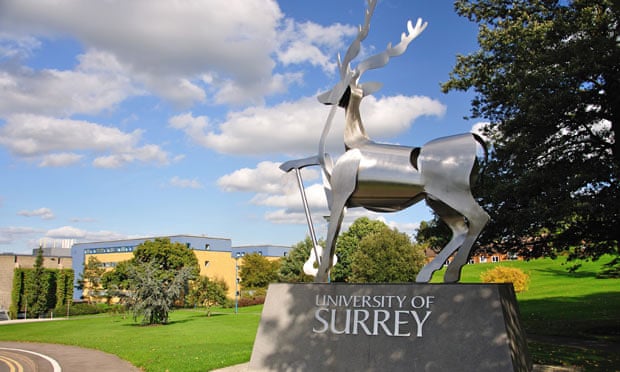
The other interesting article that came my way was from sister-magazine of the Daily Telegraph -- The Spectator -- about league tables.  It came about because the University at which I work (the University of Surrey) appeared at number four in the Guardian League table.  The Spectator article is pretty scathing of the table.  It is written by people working in recruitment and can be summed up by their quote
"From an employer’s perspective, the picture is clear and consistent: the Russell Group universities come top, led by Oxbridge and LSE. A degree from the top three will get you into almost any interview room. A degree from Surrey will not. It’s as simple as that"
I am in no sense a fan of league tables.  They attempt to quantify unquantitative things, and the results are not particularly benign, as people end up believing them, and Universities even end up making their mission not to achieve excellence but rather to improve their league table score (though one might fancy that they believe they can only do this by being more excellent).   Still, the Spectator article makes me think that league tables may not be all bad after all.  If it causes the tools of the right-wing press to snort with indignation about how the only thing that matters is to have gone to the same university of the patriarch of the company that might employ them, and that they should be wearing the right old school tie, then perhaps these league tables that rate Universities highly if they have, for example, good teaching feedback, are not such a bad thing.  

Though I've said it before -- let me reiterate about the sentence in the Spectator article about the Russell Group.   The Russell Group is a London Gentleman's Club.   It was set up by a bunch of rich men, in a London hotel. Its purpose was to be a club which you can only join by agreement of those already members, and by contributing a lot of money, and the reason to join is because you are fearful that if you aren't a member of the club then people won't like you.  That's all it is, and that's all students are paying for when they hand a Russell Group university their tuition fee, some of which is passed straight to the Russell Group as membership fee.  It doesn't matter, as long as you are happy with it -- as many people who pay fees to independent schools before going to Univeristy are.  On the other hand, if there is hope for more than the old school tie principle, then we could go for these league tables.  I'd also suggest that if you can't give the right kind of handshake to the authors who have advertised in the Spectator article that their job is to get you a job, that you don't use their recruitment company.  Sadly, the only reason that the Russell Group's premise works is because the recruitment consultants can't be bothered to do more than use the school tie principle.

It wasn't the only blog to be upset about Surrey's 4th place:  This one, concerned with music degrees, was also not happy.  A commenter on it was quick to point out that Surrey had a long tradition of being top of the class in their Tonmeister degree.