Wednesday, 8 January 2020

IoP SciNotes

Browsing the Institute of Physics list of journals, I noticed a new one, IoP SciNotes, which is "dedicated to the rapid publication of shorter research outputs across the physical and environmental sciences, including new results of any type (novel, negative or reproduced) or descriptions of scientifically valuable methods and datasets."

Allowing negative results, reproductions of existing results, or just descriptions of datasets, among other things, is an important thing to do.  Negative results are important to document, but unless you can spin them in the right way, they can be hard to publish.  Datasets that you may never get round to analysing yourself now have a home, and short descriptions of methods or techniques that don't quite feel enough for a full paper, too.  

The journal is open access and will introduce an article processing charge in future, but for early submitters, there is no charge.

The subject matter covers all of physics (but not astronomy thanks to an agreement with an existing similar journal in astronomy), and I would certainly encourage my nuclear physics readers to ensure that the journal reflects our field as much as any other.  I should start with my own contribution...

Tuesday, 7 January 2020

A new relativistic nuclear dynamics code

I note a new paper in press in Physics Letters B by Z. X. Ren et al. (doi: 10.1016/j.physletb.2019.135194) which presents new calculations of alpha cluster dynamics using a new code developed using relativistic density functional theory.  This is a method very similar to much of my research, and it's great that the authors have a production code using the relatvistic theory (my work is non-relativistic). 

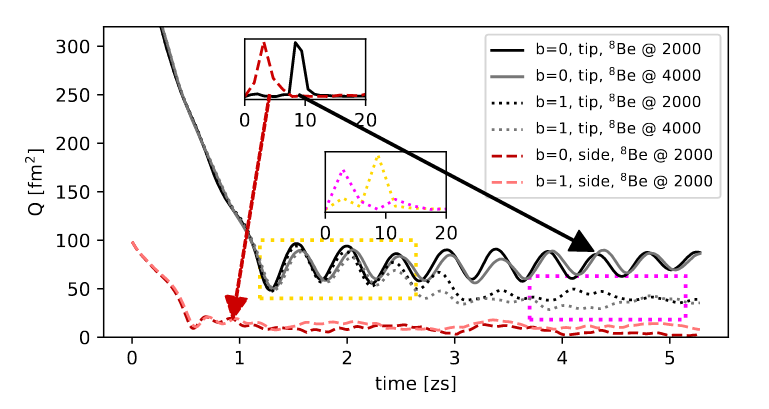
This paper on alpha cluster dynamics looks at overlapping problems to my last paper on the subject.  I note that mine was submitted on 05/09/2019 while theirs on 09/09/2019 :-) and it's good to see different methods being used for the same kind of thing.  Our plots of the Fourier strength of the quadrupole vibrations in the Be-8+alpha system ought to be directly comparable:

Spectral power for quadrupole resonances
in He-4 + Be-8 system from Ren et al. (in press)
Insets show spectral density for He-4 + Be-8
quadrupole vibrations (x-axis units are MeV) from
Stevenson et al. (in press)

In the Ren at all work, then solid peak should correspond to the same physical quantity as (probably) the solid peak in my work in the upper inset in the right figure.  Ren's units give the period of the vibration in fm/c, while I give energy in MeV.  The peak from Ren's calculation has a period of ~120 fm/c.  These strange time units are the amount of time it takes light to travel 1 femtometre (10-15 m).  That's a very short amount of time (10-15 / 3×10⁸ ≅ 3.33 × 10⁻²⁴ s = 3.33 ys = 0.0033 zs).  So 120 fm/c is 0.4 zs (zeptoseconds).  The frequency (number of such vibrations per second) is f=1/0.4 zs which is 2.5×10²¹ s-1.

According to Planck's quantization rule, these vibrations have a corresponding energy E=hf, where h is Planck's constant.  so E = (4×10-21 MeV s)(2.5×10²¹ s-1) ~ 10 MeV, so we appear to agree with each other pretty well.  That's not really surprising, since the nuclear forces we use have to be reasonable enough to reproduce the right kind of scale of nuclear properties, but it's still reassuring. 


Thursday, 2 January 2020

Squeezing Calcium Nuclei

Over the Christmas holidays, a paper appeared on the subject of giant monopole resonances in Calcium isotopes.  The title of the paper is Compression-mode resonances in the calcium isotopes and implications for the asymmetry term in nuclear incompressibility (doi:10.1016/j.physletb.2019.135185), by Kevin Howard et al., based on experimental work that took place at RCNP Osaka.

Giant monopole resonances are a subclass of "compression-mode" resonance; excited nuclear states in which the nucleus is vibrating in a spherically-symmetric way, inflating and deflating like a balloon.  A principal interest of these modes is that their properties tell us something about how much a nucleus likes being squashed.  To a first approximation, they don't like it at all.  Nuclei are (like liquids) really hard to compress.  It's not impossible, though, and measuring just how hard they are to compress tells us something about the underlying nuclear forces via the equation of state of nuclear matter.

Motivating Howard et al.'s experiment is some recent published results from Texas A&M University (TAMU) in which the energy of the giant monopole resonances across calcium isotopes were found to increase as the mass number of the calcium isotope increased.  Usually, one expects that as nuclei get heavier (and larger), the giant resonances occur at lower energy.  One can think of the vibrations as having to have nodes at the surface of the nucleus, and the wavelength of the vibration gets longer in a heavier (larger) nucleus.  Thanks to Planck's quantization rule, longer wavelength means lower energy.  More specifically in this case, there is (also) expected to be a decrease in energy when one specifically is making the nucleus more asymmetric between protons and neutrons, as happens when going from the calcium-40 to calcium-48 -- the chain in question here.  

Howard et al.'s work, then, was aimed at checking the surprising result.  Their answer is in disagreement with the TAMU data, showing instead the normal order.  The results are here in the figure from the paper (the whole thing is published open access via the link above).  The decreasing solid blue line show the results from the Howard et al. work, while the increasing red solid line is the TAMU data.  The other lines are models of various levels of sophistication.  While the new data is reassuring, in that it agrees with our understanding of nuclear forces, either a third set of experiments, or a reevaluation of the TAMU data looks in order.

The year 2020 is the year of calcium-40; the nucleus with 20 protons and 20 neutrons :-)


Friday, 13 December 2019

A new parliament

I've been back at work from paternity leave for a week, and busy with marking and catching up on work bureaucracy, and my research group.  The big news hanging over everything has been the general election.  Ever since it was called several weeks ago I had supposed that it would not go well (for people of a progressive bent) since PM Johnson was leading the voices to call it and was doing so as he thought the timing was right to secure a Conservative victory, with the main opposition polling badly.  

And so it turned out to be. The campaigns proved to be rather dark and depressing.  In particular, things like the fake news being spread with absolutely no consequence, with the current Conservative Party (presumably led by the Machiavellian advisor Dominic Cummings) seemingly the worst offenders.  

This comes along with frightening anti-foreigner rhetoric with Johnson bemoaning that EU citizens in the UK had been treating it like their own home.  These are citizens who have come and made the country their home, and been welcomed.  

This, too, comes after Johnson threw moderate MPs out of his party, illegally suspended parliament, and made a series of ridiculous sloganistic promises he couldn't possibly deliver (I will deliver Brexit, do or die!) in the last parliament.  

The media have largely colluded with him, with attacks by the press on the judiciary, on parliament when it opposes the government.  This has all led, in my view, to a very extreme Conservative party, which has little bearing to Conservative parties of the recent past. God knows I was not much of a fan of those, but today's version has burnt up the rule book of even the pretence of fair play, and stoked up mass hatred and a them-and-us situation.  The word traitor is bandied about frequently.  Hacked Twitter posts threw doubt on a story of a boy sleeping on a floor in a hospital and BBC journalists hungrily lapped up the fake news, with inconsequential apologies after the damage was done.  Most reports begin "according to a government source" as the news media simply relays Cummings's proganda.

When Johnson first became PM, elected by the Conservative party then, not the general public, he announced without apparent irony that the mantra was to "Deliver Brexit, Unite the Country, and defeat Jeremy Corbyn". Clearly it is not possible to put as a top priority defeating the opposition while at the same time uniting the country, and he has been particualrly divisive.  Those Conservative MPs that sought to moderate him were simply expelled.  The Conservatives policies mean that the Brexit Party stood down candidates so as not to compete against them, and why not, when the Conservatives have absorbed much of what the Brexit party stand for.

So, today the results of the election are known and Boris Johnson remains our PM, and parliament reconvenes on Monday with a Conservative majority. 

The Conservative manifesto has been pretty light with promises (except the repeated mantra to Get Brexit Done), though they have promised to double research spending.   Of course, that is something that a research scientist might like the sound of, but so far I have only heard dismay amongst my colleagues about the election result, fearing that we all will pay a heavy price one way or another.  Of course, some of my colleagues, though not many, are right-leaning.  I don't know if they approve of the current form of the Conservative party or not... please comment below if so / not!

Johnson also specifically mentioned nuclear physicists when talking about who would be allowed to come into the country in future:   

He told Sky News: "People who, you know, are first violinists, nuclear physicists, prima ballerinas, whatever - they're going to come in, startup kings and queens, they're going to come in, simply by virtue of what they can contribute.

I don't suppose many nuclear physicists will want to come to Britain as entrepreneurs, but we'll see.

Well, that's my feelings today when everything appears darkest.  It will appear lightest to many, since after all this is what the vote of the population gave us.  Life will go on...

Friday, 22 November 2019

This is the Kit

This blog's quietude over the last month has been largely due to this being the time of year when my teaching and administrative duties are concentrated.  Not that this means I can't find the time to pass on some nuclear physics news, or more personal musings, via this blog, but I haven't done so.  Partly this is due to a kind of depression at the state of politics in the UK right now (which is a whole blog post in itself).  The other reason I've been preoccupied is trying to ensure I get everything I need to done before my son is born. It's not necessarily ever possible to "get everything done I need to" because there is always more stuff to do, but in any case, the arrival yesterday of a boy, Kit, means that I am going on paternity leave from Monday.  Here he is, being hugged by two of his his siblings, and with a bit of head support from mum:


Monday, 21 October 2019

Prize-winning 288 Bar and Wok

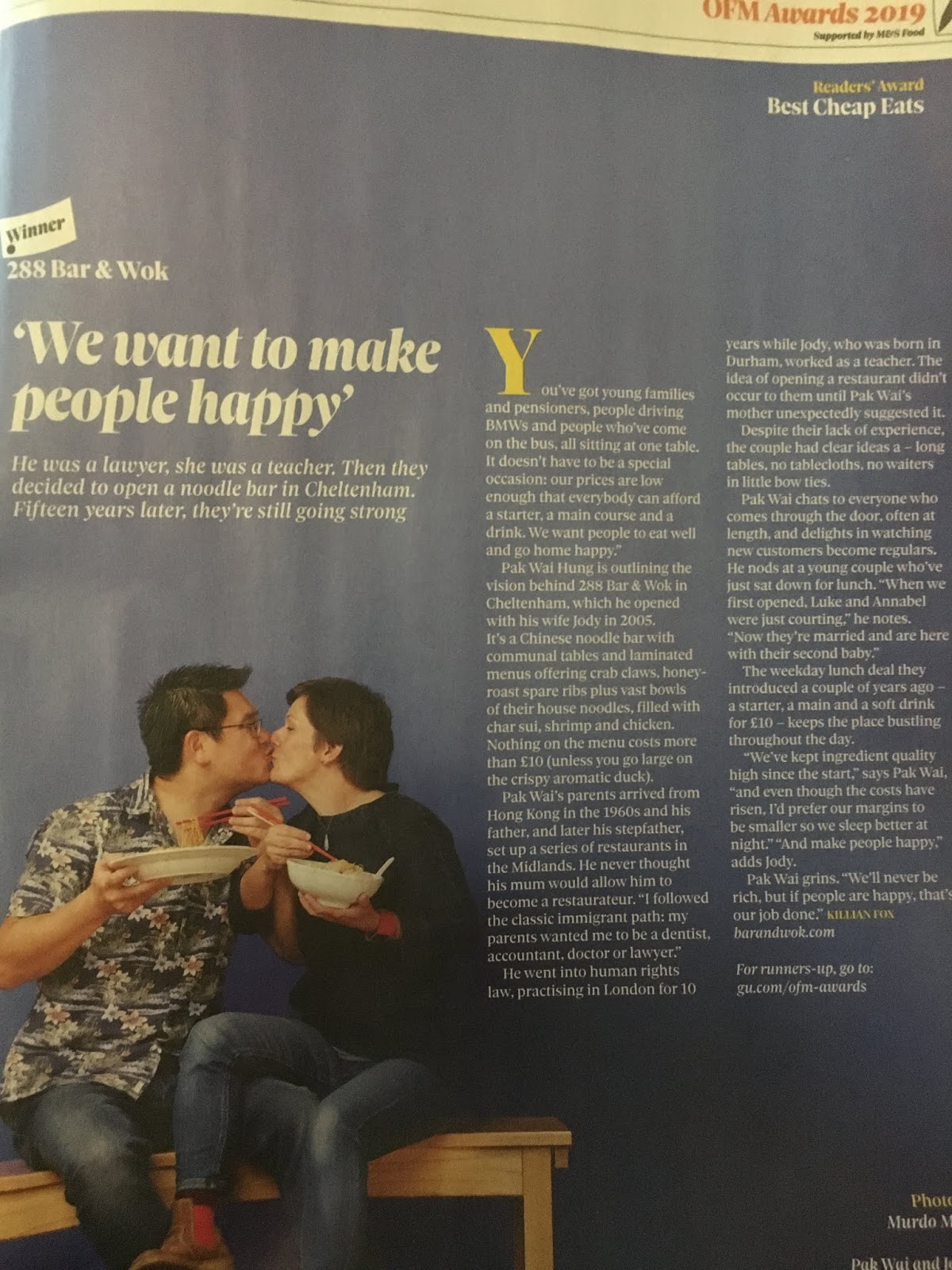
I often buy the Observer on Sundays and usually don't read the Food Monthly magazine on those weeks when it appears.  Yesterday, however, I did open it to enjoy reading about the prize given to 288 Bar and Wok in Cheltenham in Observer Food Monthly's awards, in the category "Best Cheap Eats".  The owners, Jody and Pak Wai Hung are friends of mine, dating back to school days, where I first met Jody.  We haven't been brilliant at keeping in touch (story of my life) but we stayed with them a couple of years ago when we were in Cheltenham and had a lovely couple of days with them and their family.  And lots of great food.

One of the other winners of an award (in the category of Best Food Personality) is Jamie Oliver.  I half-knew Jamie from school.  He was in the year below me, and I certainly knew who he was, but I can't claim that we were friends.  I knew his wife Jools a bit better, as she came to my school in the sixth form (like Jody did - it was a boys school up to sixth form) and was then in the same year as me.  

It's a funny coincidence for a so-so state comprehensive school in Essex that I doubt very many people have picked up on, that it produced two winners in this years Observer Food Monthly awards.  Anyway, congratulations to Jody, Pak Wai, and Jamie.


Wednesday, 16 October 2019

Fission in York

Just had a busy and productive three days in York, attending a workshop in which we (the attendees) boldly have been trying to hash out the remaining problems in the theory of nuclear fission.  It's one of the most complicated processes that nuclei undergo, so the remaining problems in terms of a fully microscopic quantum theory are more or less "everything".

We will be producing a white paper as a statement of where we see the future of the field in due course, with a deadline for producing something in just a couple of weeks away to make sure we don't let the discussions be forgotten.  I excused myself from leading the coordiantion of part I am most involved in as I will be on paternity leave at an unspecified (but soon) future date.

York is a lovely city, and I didn't get to see much of it this time.  The meeting was in the King's Manor, an old mansion in the centre of town that now belongs to the University of York, and I stayed very close, between there and the Minster, so I did get a little bit of vicarious tourism in.  The picture is of King's Manor.