I wonder if readers have noticed the similarity between footballer & sex-symbol George Best and nuclear wunderkind and Nature-botherer Liam Gaffney?
 |
 |
| Best | Gaffney |
I wonder if readers have noticed the similarity between footballer & sex-symbol George Best and nuclear wunderkind and Nature-botherer Liam Gaffney?
|
|
| Best | Gaffney |
My department are offering a fully-funded PhD studentship to candidates from under-represented groups. It is loosely tied to the IoP Bell Burnell Scholarship, and we would seek to submit an application to the IoP for the successful candidate, though the university guarantees funding even if the IoP bid is unsuccessful
More details are here.
I did post this on Twitter already, trying to see if anyone there might be interested in applying for the studentship with me. I got one angry (or "disgusted") respondent who does not like this kind of scheme. The point is that the word "under-represented" means less represented than you would expect if there were not a long-standing systemic bias against particular classes of people. Those who don't fall in the "under-represented" category already have plenty of opportunity to get into they system, as seen by their over-representation.
This studentship is unusual (compared with any other studentships that have been used to fund students I've taken in the past) in that it even international students are eligible, which is usually not the case for government-funded places.
We have been having some work done at home, to have our loft changed into a bedroom and an office for home working. We have had a bookshelf built in to one of the rooms, and it has just been populated by books, so finally I can take a photo and have proper background to my Zoom calls, which I understand is supposed to be a full bookcase

It's the middle of the semester, and it's my busiest semester, in which I teach two full 15-credit final year modules – i.e. I am teaching half of a student's full time effort, and with the extra preparation of online lectures, online tutorials, videos of answers to problems, more time on online discussion, as well as all the non-teaching parts of my job, I am finding myself working after the family has gone to bed most days. Not a position I ever try to get myself in, but I'm more or less resigned to it for the rest of semester.
For most of my lectures and problem solution walk-throughs I'm using a video of me writing on a tablet device, accompanied by my voice. It works tolerably well, though not without glitches. I'm getting increasing adept at re-opening the whiteboard app when part of my writing hand accidently touches a part of the screen and closes it. At the same time, my usage of mild swear words has never been higher, and no doubt the students will also be saying crivvens whenever they need to express some slight horror.
Some of the problem solutions I've been working through involve sticking in actual real-life numbers into calcualtions. These are calculations a bit too complicated to do mentally, and I rarely find myself in need of doing such calcualtions so that I don't have an old-fashioned calculator to hand. I have, of course, a computer, and also a smart phone, and usually I end up using the calcualtor function on my smart phone. As I wrote an equation on my tablet a couple of weeks ago, I did find myself musing that it would be nice if there were an app to recognise the equation and do the sums for you. Lo and behold, of course there is. One of the courses I am teaching right now involves the use of the programming language Maple and there is a app written by the Maple people called Maple Calculator. It has exactly this function; you can take a picture of some mathematics with a camera, it will recognise it (hopefully) and then evaluate it for you.
Here is an example of it working out a calculation for a kinematics problem in special relativity:

I tried to make sure that I wrote the equation very neatly, and indeed it seemed to recognise it okay. The answer, though, is not what I was expecting. The actual answer is around 1.73. It took me a little while to understand why...
While we wait for all academic publishing to be properly open access, Royal Society Publishing have kindly opened up their pretty extensive archive for free for the next week. See here.
They do not have an extensive amount of nuclear physics stuff, but they are currently my publishing BFF because they published my student's article on Terrell rotations earlier this year, whcih I may have metioned here before. More than once. In fact, more than twice. Well, modesty prohibits me from linking to the paper again, but that's okay because there are lots of other articles of interest, dating back, of course, many centuties.
If anyone has any favourite articles from Proceedings of the Royal Society, or the Philosophical Transactions, please do share in the comments.
Here's a snapshot of some sketches by William Herschel, from Philosophical Transactions, vol 74, p233 (1784)

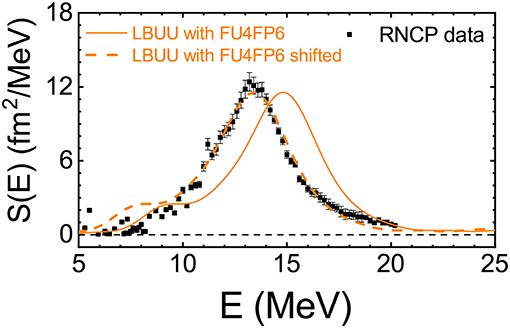
That leaves just one more paper to appear, and also means that I should get on with writing the editorial in time to make a free e-book of the Special Topic.
Roger Penrose was announced this morning as the winner of half of the 2020 Nobel Prize in Physics, with the other half being shared equally between Andrea Ghez and Reinhard Genzel. I will leave others to explain about the physics behind the prize award, since it is not really my area of expertise, but I wanted to post to mention the ways Penrose and his work has cropped up in my life
As a physics-interested schoolboy, I used to read through popular science books. Probably the first one I read, to the best of my memory, was Stephen Hawking's A Brief History of Time, which I got for Christmas the year it came out and was something of a must-read book for more or less anyone, though there was a kind of joke that few people finished it. I did finish it, and though I probably didn't understand it all, I found it at least readable and understood the words and got a sense always of the ideas being communicated, even if perhaps I didn't always gain a deep understanding.
Another one I read, while I was in the lower sixth (what we used to call Year 12) and applying to University, was Penrose's The Emperor's New Mind. I lent my copy to a girl I fancied and never got it back. I later learned that the rule of lending books to anyone was that you just go out and buy yourself another copy straight away. Anyway, I had finished the book, though I'm not sure I can remember too much of it in great detail now. It did make quite an impression on me at the time, though I think it was "harder" than Stephen Hawking's book and no doubt there was lots I didn't understand. I liked it for its broad sweep, combining ideas from physics to advanced mathematics, Turing machines, and on to somewhat more speculative stuff (which I didn't distinguish at the time, I suppose) to do with consciousness.
In December of 1991, when I was in the lower sixth and up in Oxford for an interview to read Physics and Philosophy I noticed that Penrose was giving a lecture for prospective students in Mathematics. In my interview for my place in college when asked if I had any questions I said I'd seen the advert for the talk and I asked if it would be okay if I went along to it. I'm not sure what they thought of my question - I guess I had no idea at the time that it would be perfectly fine for anyone to turn up and they wouldn't exactly be checking to see if I was really a prospective mathematics student. Anyway, I went along, and enjoyed the talk very much. Penrose talked about the famous Penrose tiles. I remember particularly a demonstration of how for certain near-symmetries you could make the symmetry almost perfect - as near to perfect as you liked, except not quite actual perfection - and he showed this by having two identical overhead projector slides with a 5-fold Penrose tiling, which he overlaid, and you could see the bands made in the thin regions where the pattern didn't quite repeat.
I don't think I have seen Penrose in person since then, 29 years ago, but I did get a copy of his huge "The Road To Reality" book as a 30th birthday present a bit later (in 2004). That's been sitting on my office shelves unread, I have to admit. I'm sure, as a practicing theoretical physicist, that I ought to be able to read and understand it, but even to me, opening it up it does look intimidating.
The other Penrose anecdote I have is that I found out at some point (perhaps the advent of wikipedia) that I share a birthday with several famous physicists, two of whom won Nobel prizes long ago). Now I can fill in another cell in this table:
| Physicist | Date of Birth | Year of Nobel Prize |
| E.O. Lawrence | 08/08/1901 | 1939 |
| P.A.M. Dirac | 08/08/1902 | 1933 |
| R. Penrose | 08/08/1931 | 2020 |
| P. D. Stevenson (me!) | 08/08/1974 | - |
The final Penrose-related thing links with my research: Earlier this year I co-published a paper with a bachelor's student based on his Final Year Project on the visual appearance of objects moving very fast (at an appreciable fraction of the speed of light). This is a new look at something which are either called Terrell Rotations, after the author who first got his name attached to it, or as the Penrose-Terrell effect, since Penrose independently submitted a paper on the same topic, published in the same year as Terrell. Even more properly, it can be called the Lampa-Terrell-Penrose effect, since Lampa published it first, in a paper that wasn't so widely known.
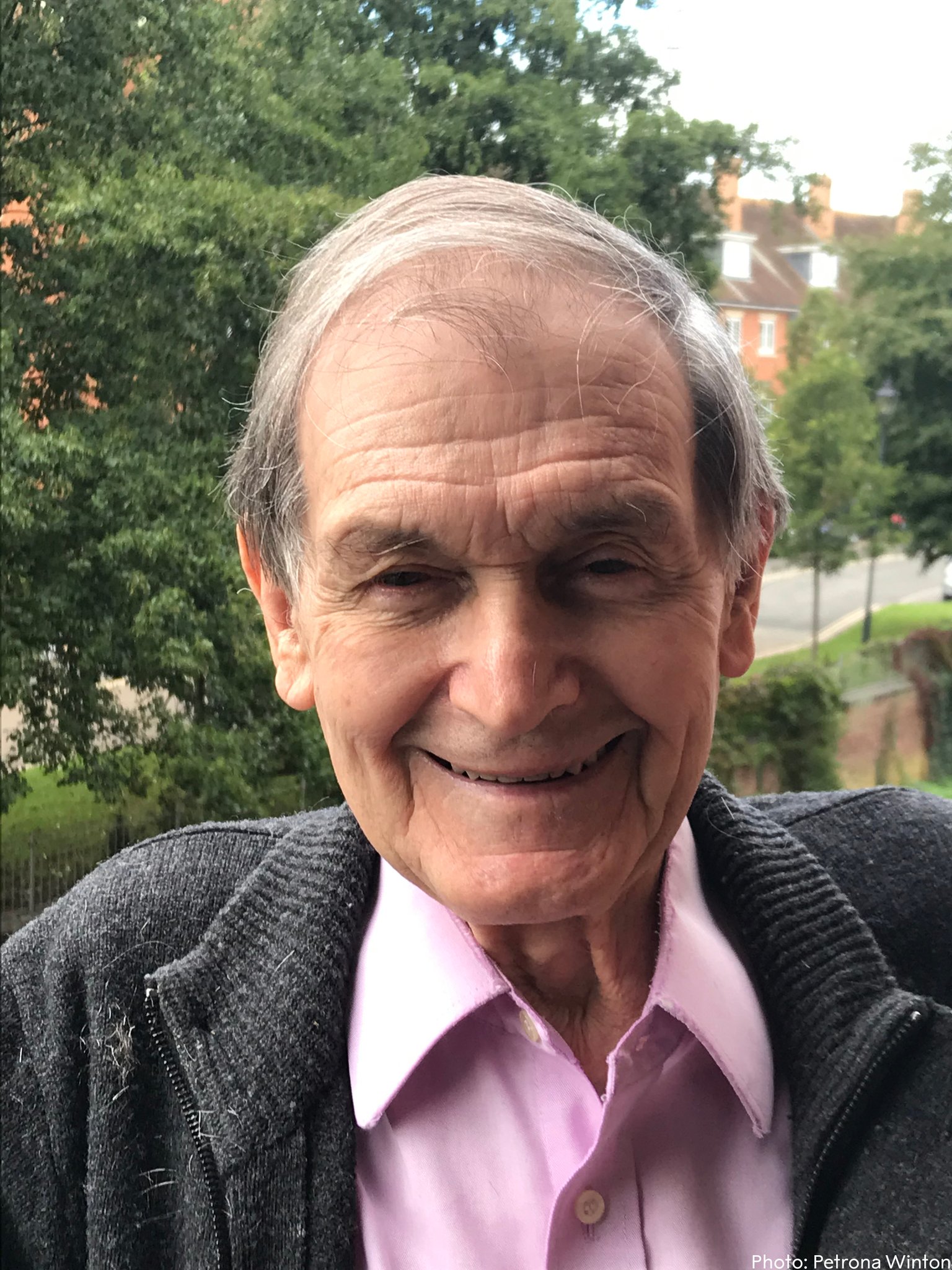
Here's a picture of Penrose, which he sent to the Nobel Committee from his house in Oxford this morning