Thursday, 7 January 2021

RIP Bill Rae

The sad new of Bill Rae's death has been brought to my attention by my colleague and friend Wilton Catford.  Wilton knew Bill considerably better than I did, and he (Wilton) has kindly let me share the following obituary of him:

Some of you working in the same research area as me will have heard of Bill Rae and maybe even have known him. Bill was a friend of mine and one of the most gifted nuclear physicists that I have met. We've just heard via a mutual friend Dick Hunt that Bill has passed away, so I'd like to pass that information along. 


Bill was born in 1951 in Scotland and was very Scottish. From 1976 to 1978 he initiated and wrote OXBASH, deliberately designed as a shell model code that could be accessed and used by experimenters. It remained one of the most powerful codes in the field until Bill completely rewrote it in 2005, calling it Nushell. 


In 2006, he wrote a different programme that used new innovations in matrix multiplication to hugely extend the capability - this was called Nushellx and remains one of the world leaders. During the 80s and 90s, Bill became a Fellow of both Trinity College Oxford and St Cross College Oxford. Bill was forced to retire at age 50 in 2000 due to the debilitative effects of Parkinson's Disease, which eventually stopped him programming at his home in Garsington (just outside of Oxford) in 2009 but which he fought off for nearly 30 years. Amongst other things, he subsequently invented his own walking stick (cane) with a laser (of illegal power, bought through eBay to his great amusement) that allowed him to walk in a straight line by following the red dot on the ground. 


Bill is best known for the shell model work, but he also began a renaissance in alpha-clustering work both experimentally and theoretically. He wrote a new code in the 1990s to use the Brink model and extensively published new results, and he personally designed with Dick Hunt the electronics for the world's leading (at the time) multichannel data acquisition system for silicon strip detectors which underpinned the cutting-edge work of the Charissa collaboration (which he founded) in the UK and at laboratories in France, the USA and Australia. 


At times taciturn, his sense of humour was as rapier sharp as his scientific brilliance and he was a pleasure and an inspiration to work with. Vale, William Dickson Mudie Rae.


W D M Rae in 2007, courtesy B A Brown


Thursday, 17 December 2020

Nuclear Spot The Difference #10

 I wonder if readers have noticed the similarity between footballer & sex-symbol George Best and nuclear wunderkind and Nature-botherer Liam Gaffney?

Best Gaffney


Thursday, 10 December 2020

Bell Burnell Diversity PhD studentship at Surrey

My department are offering a fully-funded PhD studentship to candidates from under-represented groups.  It is loosely tied to the IoP Bell Burnell Scholarship, and we would seek to submit an application to the IoP for the successful candidate, though the university guarantees funding even if the IoP bid is unsuccessful

More details are here.

I did post this on Twitter already, trying to see if anyone there might be interested in applying for the studentship with me.  I got one angry (or "disgusted") respondent who does not like this kind of scheme.  The point is that the word "under-represented" means less represented than you would expect if there were not a long-standing systemic bias against particular classes of people.  Those who don't fall in the "under-represented" category already have plenty of opportunity to get into they system, as seen by their over-representation. 

This studentship is unusual (compared with any other studentships that have been used to fund students I've taken in the past) in that it even international students are eligible, which is usually not the case for government-funded places.

Thursday, 26 November 2020

A proper Zoom backdrop, finally

 We have been having some work done at home, to have our loft changed into a bedroom and an office for home working.  We have had a bookshelf built in to one of the rooms, and it has just been populated by books, so finally I can take a photo and have proper background to my Zoom calls, which I understand is supposed to be a full bookcase


Wednesday, 4 November 2020

Online teaching & Maple Calculator

 It's the middle of the semester, and it's my busiest semester, in which I teach two full 15-credit final year modules – i.e. I am teaching half of a student's full time effort, and with the extra preparation of online lectures, online tutorials, videos of answers to problems, more time on online discussion, as well as all the non-teaching parts of my job, I am finding myself working after the family has gone to bed most days.  Not a position I ever try to get myself in, but I'm more or less resigned to it for the rest of semester.

For most of my lectures and problem solution walk-throughs I'm using a video of me writing on a tablet device, accompanied by my voice.  It works tolerably well, though not without glitches. I'm getting increasing adept at re-opening the whiteboard app when part of my writing hand accidently touches a part of the screen and closes it.  At the same time, my usage of mild swear words has never been higher, and no doubt the students will also be saying crivvens whenever they need to express some slight horror.

Some of the problem solutions I've been working through involve sticking in actual real-life numbers into calcualtions.  These are calculations a bit too complicated to do mentally, and I rarely find myself in need of doing such calcualtions so that I don't have an old-fashioned calculator to hand.  I have, of course, a computer, and also a smart phone, and usually I end up using the calcualtor function on my smart phone.  As I wrote an equation on my tablet a couple of weeks ago, I did find myself musing that it would be nice if there were an app to recognise the equation and do the sums for you.  Lo and behold, of course there is. One of the courses I am teaching right now involves the use of the programming language Maple and there is a app written by the Maple people called Maple Calculator.  It has exactly this function; you can take a picture of some mathematics with a camera, it will recognise it (hopefully) and then evaluate it for you.

Here is an example of it working out a calculation for a kinematics problem in special relativity:

I tried to make sure that I wrote the equation very neatly, and indeed it seemed to recognise it okay.  The answer, though, is not what I was expecting.  The actual answer is around 1.73.  It took me a little while to understand why...


Monday, 19 October 2020

Open Access Royal Society (one week only)

While we wait for all academic publishing to be properly open access, Royal Society Publishing have kindly opened up their pretty extensive archive for free for the next week.  See here. 

They do not have an extensive amount of nuclear physics stuff, but they are currently my publishing BFF because they published my student's article on Terrell rotations earlier this year, whcih I may have metioned here before.  More than once. In fact, more than twice.  Well, modesty prohibits me from linking to the paper again, but that's okay because there are lots of other articles of interest, dating back, of course, many centuties.  

If anyone has any favourite articles from Proceedings of the Royal Society, or the Philosophical Transactions, please do share in the comments. 

Here's a snapshot of some sketches by William Herschel, from Philosophical Transactions, vol 74, p233 (1784)


Tuesday, 6 October 2020

Lattice calculations of nuclear vibrations

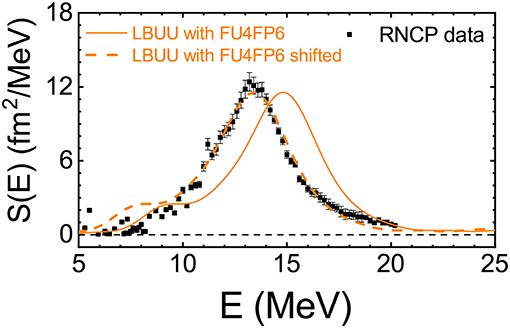
  I just received a notification that the penultimate article in the special topic in Frontiers In Physics that I am co-editing has appeared.  It's called "Nuclear Collective Dynamics in Transport Model with the Lattice Hamiltonian Method" and it deals with a method in which the motion of a nucleus is described in terms of the the evolution of the Wigner function (the nuclear density Fourier-transformed to the momentum representation).  By including collisions between nucleons in the formalism, the authors describe the width of giant resonances rather well, as shown in the picture above (fig 7 from the paper).

 That leaves just one more paper to appear, and also means that I should get on with writing the editorial in time to make a free e-book of the Special Topic.