Friday, 21 June 2024

2023 Journal Impact Factors

I see that the 2023 Journal Impact Factors (JIFs) have been announced.  While I take them with a pinch of salt, as I am able to judge quality of articles by actually reading them, JIFs are an interesting artifact of the research environment, not least because so many people seem to take them seriously.

In the "PHYSICS, NUCLEAR" category, there are 20 journals, with the top two predictably being review-only journals.  For the regular journals, where you can openly submit papers, there are not too many surprises:  The journals which combine particle and nuclear phsyics, but which are nevertheless included in the "PHYSICS, NUCLEAR" category, do better than nuclear-physics-only journals.  So Physics Letters B, Chinese Physics C and J Phys G outrank Phys Rev C, European Physical Journal A and Nuclear Physics A.    

The one unexpected result for me is the high score of Nuclear Science and Techniques.  The journal combines nuclear physics of the sort I do, with "nuclear science" - meaning things to do with applications of nuclear physics, such as nuclear reactors, or radiation physics.  Such areas do not usually bring JIFs up as applied physics tends not to be highly cited.  The journal has been somewhat under my radar.  I don't make a habit of looking there for new papers, though I see there are some interesting nuclear physics papers there, alongside nuclear science articles a bit far from my main interests.  It's a China-based journal, though published by Springer, and the authorship is heavily China-based.  

One may speculate why it is doing so well in impact factor. The JIF number has jumped out quite a bit this year to put it in the top quartile by category.  I don't know the answer as to why.  It may simply be the fact that the journal is heavily used in China and the volume of reesarch coming out from China, whose authors are aware of and citing other work from China, is ever-increasing.  Let me know what you think!

Since I like to include a picture for each post, I scanned a list of open access papers in the journal and found the one closest to my own interests - The 5𝛼 Condensate State in Ne-20 by non-Chinese author Takahiro Kawabata.  It shows a schematic picture of an alpha-cluster state in neon-20 compared to the non-clustered ground state.


Friday, 14 June 2024

Hackathon wrap-up

As mentioned in a previous post, we (me, postdoc Abhishek, and student Grant) were in Edinburgh attending a hackathon run by DiRAC, the computing arm of the UK STFC funding agency, and Codeplay, an Edinburgh-based company with expertise particularly in the Intel architecture of hardware and software.

At the start, we had our code (Sky3d) which runs on CPU and makes extensive use of a CPU-based fast Fourier transform library (fftw).  By the end, we had, with extensive help from the DiRAC and Codeplay engineers, a code which was mainly hosted on the CPU but which offloaded parts of its operation to a GPU coprocessor.  In particular, we were able to interface to a custom set of fft routines which are part of the Intel MKL library and which we were able to use fftw wrappers for.  This was all pretty exciting - we are using the latest hardware, with very new compiler technology, to run our code.  The hope is that it should end up running so much faster that we will be able to attack physics questions that are just too hard / time consuming to answer right now. The down side is that so far, the GPUified code actually runs slower than the CPU-only code.  This is presumably because it is spending time shunting too much data between the CPU memory and the GPU memory and not enough time powering through calculations on the GPU.  So we still have a lot of work to do to get a fully optimised GPU version of Sky3d, but at least we have started now.

At the end of the three day event, Grant and I went to a chip shop.  Grant tried the local delicacy of a deep-fried battered Mars bar.  He liked it.  I didn't fancy one but have tried one before and think they're pretty good! 

Grant with a deep-fried battered Mars bar


Thursday, 13 June 2024

Developing quantum computing algorithms for the nuclear shell model

Today our new paper appeared (as an "in press" draft) in the New Journal of Physics.  In it, we develop quantum computing circuits that can produce eigenstates in the nuclear shell mode.  This nuclear model, called "configuration interaction" in other areas of many-body quantum mechanics, such as quantum chemsitry, is probably the main approach that realistic calculations of nuclei have been attempted on quantum computers by various groups.

Our paper is by no means the first to explore how to apply quantum computing to the shell model.  What we have done, though, is to use a circuit ansatz inspired by the nuclear physics and the symmetries involved to use a small number of gates, and a small number of variational parameters in order to turn the initial "zero" state of the quantum computer register into a state which simulates the nuclear wave function. 

The result is that we are able to find, with relatively low-depth circuits, the ground state, lowest 2+ and 4+ states, on a simulated quantum computer with good accuracy.  

We had some useful comments from the referees pointing us to how we might be able to reduce the circuit depth further, and we will look into that.  We also would like to really test the circuits on a real quantum computer.

Here's an example circuit - probably our most complicated one - that finds the 2+ state of Nickel-58


Tuesday, 11 June 2024

Hackathon in Edinburgh

 I had an early start today (alarm set for 4:10 am) for a three-day trip to Edinburgh, where I'm attending a hackathon with my colleagues Abhishek and Grant.  The idea is that there will be some experts here in the latest coding technologies for running codes on the latest GPU hardware, and they will help us transfer our CPU-based code to GPU where it should be able to run much faster, enabling us to tackle physics cases that are currently too hard for us. 

So far, it has been going okay - some steps forward and some technical issues holding us back, but we're only half way through the first day of three.

Edinburgh is a pretty city and if I had taken a photos I could include them here.  I haven't (yet), so instead, here is the tweet from the DiRAC_HPC Twitter account, which features our team in the foreground table.  You can see Grant and Abhishek and a tiny bit of me at the right of the picture


Friday, 3 May 2024

Open Access in Nuclear Physics

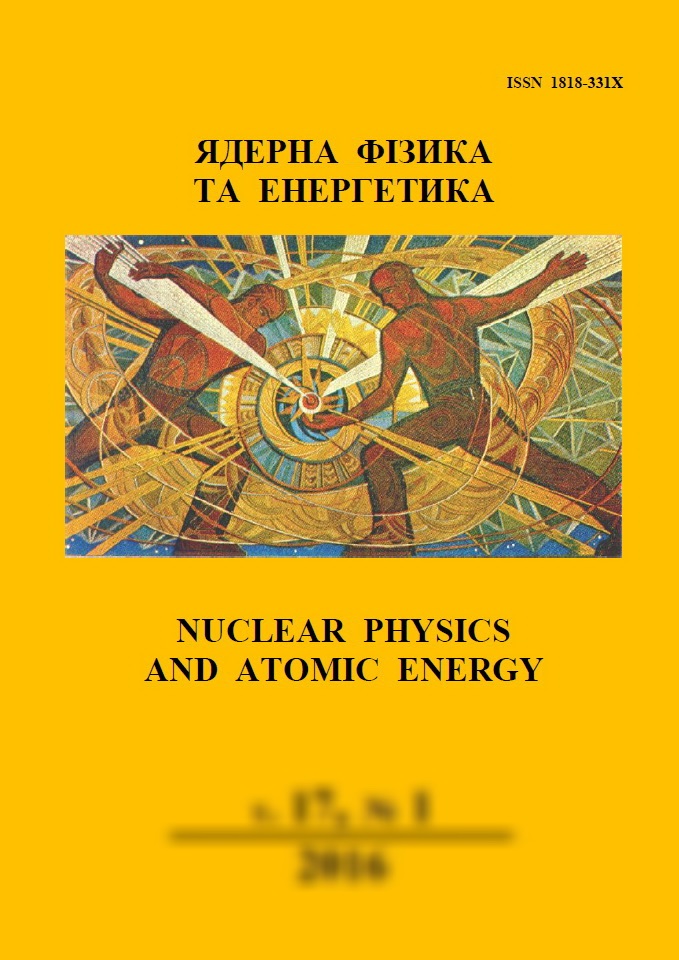
 Thanks to the trawling majesty of Google Scholar, I came across a paper published in the Ukrainian journal Nuclear Physics and Atomic Energy which cites a paper of mine.  The article itself presents some nice calculations of giant resonances in tin nuclei.  Though I have been aware of this somewhat obscure journal before, I hadn't quite realised that it is free to publish in and open access.  It is listed in the Directory of Open Access Journals, pointing out that not only is it free to publish in, but authors retain full rights, and the papers are published as CC BY-NC license.  So, all in all, it ticks all the boxes.  I must say, I also like its basic html feel and the idea of supporting a journal published by the Ukrainian nuclear physics community is also appealing.  

The only weird thing about it is that submissions must come with a cover letter signed by your Head of Department. Oh, and the papers must be written in Microsoft Word, which is also a bit of a weird requirement.


Tuesday, 30 April 2024

Th-229 isomer breakthrough

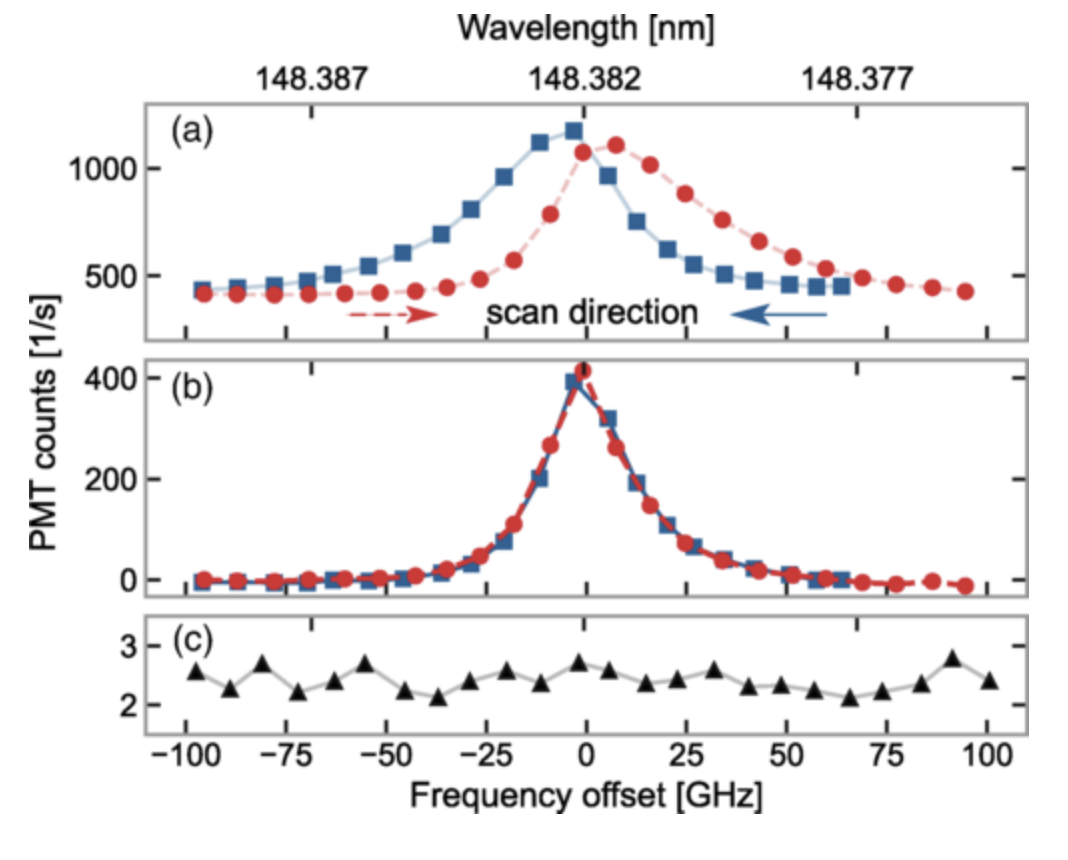
 A group in Germany has just published a paper showing a huge improvement in accuracy in measuring the energy and lifetime of the lowest-lying nuclear excited state that we know about - the 8.4 eV isomeric in Th-229.  While typical nuclear excitation energies are around one million electron-volts (1 MeV),  the relatively tiny energy of the thorium isomer puts it in the kind of energy range that can be manipulated by optical equipment.  In the case of the published work, the authors developed a bespoke ultraviolet laser that was able to sweep the right candidate frequencies to pin down the isomer energy to an accuracy of nearly 1000 times better then the previously best measurement.  

This isomer is not just a quirky curiosity:  A long-lived low-energy state in a nucleus, which is much better isolated from environmental effects than an electron in an atom or molecule, has the possibility of being used in applications such as a nuclear clock, potentially surpassing atomic clock timekeeping, as well as other possible quantum technology applications such as qubits for a quantum computer, or a quantum sensor to test fundamental physics. 

Plot from the (Creative Commons open access) paper below showing the resonant peak in the frequency scan:


Thursday, 25 April 2024

16 year erratum

 There is an erratum published in Physical Review C this week which corrects paper from 16 years ago.  In their opening sentence they own up to adjusting the data in a way they shouldn't have:

In our original publication of level scheme of 104Nb, we determined level energies based on certain transitions and subsequently adjusted the raw data for other transitions to fit these energies. This is not correct scientific procedure as it alters original data, and it risks introducing incorrect transition and level energies into the literature. The main purpose of this erratum is to provide the original data.

and go on at the end to 

thank the Physical Review C editors and the data scientists at the National Nuclear Data Center at BNL for calling our attention to these corrections

To me, this shows that processes are working and that the data from their paper, which made its way into databases, was found to be erroneous, the error investigated, and corrected.  Too bad it happened in the first place, but the data remained available for scrutiny and the scrutiny worked.