Wednesday, 23 February 2022

PDRA positions in York

The University of York nuclear physics group is currently advertising for three post-doctoral researchers to work with them.  This is excellent news for the group there, indicating as it does great success in having their peer-reviewed grand proposals funded, with three full-time researchers enabling them to carry out the promised research.  It's also good news for the UK nuclear physics community, and in particular the very small theory component of it.  Especially it is good for those looking to secure a post-doc in nuclear theory, based in a lovely city. 

The deadline for applying is 18th March.

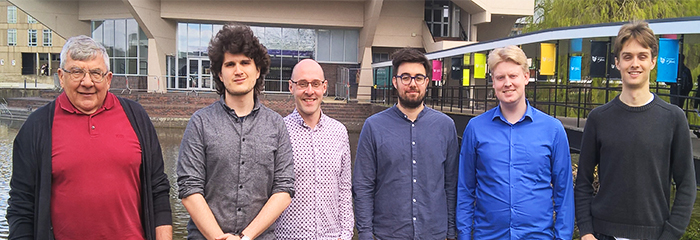
Here is an image I found of the theory group at York, probably taken before the pandemic!  As I understand it from the job advert, the Principal Investigator on all three projects is Prof Jacek Dobaczewsku, on the left in the picture


Monday, 21 February 2022

doi on arxiv

 My last post was about the arXiv and now there is more news to report about it:  All papers posted there since the beginning of 2022 will have a doi assigned.  This is excellent news, as the doi has become such a standard way of providing a link to an online article.  I assumed that that the reason this hadn't been done in the past was because of the non-zero cost of having a doi assigned.  I don't know what the cost is, but I guess it was not so much of a hindrance after all - and of course arXiv is not free to run, but it does have sponsorship and institutional funding, and presumably the arXiv board arrived at the decision that subscribing to the doi system was worthwhile and affordable. 


Tuesday, 8 February 2022

From arXiv to ar5iv

A little while ago I posted about a website which took arXiv articles and presented them as html for better reading on devices such as phones where pdf does not work so well.  Now I've come across another one, ar5iv which makes html5 versions of arXiv papers (where the original is in LaTeX).   To use it you can just replace the X by a 5 in the URL of a paper and hopefully it will return a readable version.  

Here's an example from a paper writing up a summer student's code.  It seems to work pretty well even with the LaTeX package we used for pretty-printing the source code in an appendix.  


Tuesday, 1 February 2022

Nuclear reactions breaking causality?

In response to a tweet about a paper taking a long time to get published, Toshihiko Kawano of Los Alamos tweeted about a paper of his that appears to violate some physical laws in its publication.  Good job Toshihiko!


Saturday, 29 January 2022

Having Covid-19

 I managed to get this far before getting Covid, but with four children in four different schools, and with three of the children under 12 and hence not vaccinated (since that is the regulation in the UK) it seemed only a matter of time until we got it.  It seems to have been rife in my 5yo's school, and we tested him, even though he did not have symptoms before sending him to a trampolining party in an encolsed space.  He tested positive, was pretty stoical about it, even about missing the party, and he is now the first to get through the other side and testing negative again.  Meanwhile, I and my partner have it.  It has been hard work both being ill at the same time and having to keep the kids home because of the Covid in the house, all the while trying to get through a few most-vital work tasks.  

The line on my own lateral flow tests is fading, and according to the UK rules I can return to society on Tuesday no matter what (even if testing positive).  I see in the national statistics of case number that though we are past the recent peak, we are sitting on a smaller peak, or shoulder to the main peak which seems to me to be thanks to schools going back after Christmas, with younger years having no masks, no vaccinations and really no precautions at all.  


Wednesday, 29 December 2021

Books of 2021

Here are the list of books I've read in 2021: https://www.goodreads.com/user_challenges/25611691

I use the Goodreads website to keep track of what I've read, and set a somewhat arbitrary "reading challenge" each year in terms of number of books.  This year I met the target exactly, though I do include books I read my 8 year old, which perhaps I shouldn't, and don't include the much shorter books I read my younger children.  I'm not sure much would be gained by adding a selection of Mr Men books multiple times to my reading record.  I think I have missed a couple of the (excellent) How To Train Your Dragon books off the list.

From the list, I think I have cemented my view that I particularly enjoy biographies (auto, or otherwise), and found Lea Ypi's Free, Gyles Brandreth's Odd Boy Out and Tara Westover's Educated among my three favourite.  The first and last of those also appeal to my sub-genre of early-mid career academic types reflecting on their life so far (see also, The Lost Properties of Love by Sophie Ratcliffe and Red Threads by Charlotte Higgins).  I read relatively little fiction this year, except to my 8 year old, but I enjoyed each of the small selection in its own way, and it must be in Elizabeth Day's favour that I made my first foray into her work (The Party) and then wanted to follow it up with her new release this year, Magpie.

Probably the longest book, and one that I spent a lot of time immersed in and really enjoying was Orlando Figes' The Europeans.  A history of a period in Europe, roughly spanning the life of opera singer Pauline Viardot and concentrating on the cultural history, I found myself gripped, even if I am largely ignorant and not particularly intersted in opera.  

edit: I have realised thanks to a comment on Twitter that the Goodreads website will only let those logged in to see the list.  Here are screengrabs of the lot in reverse chronological order (so Educated is the last one I read):


Tuesday, 23 November 2021

No prize winners on UK visa scheme

 New Scientist published a story yesterday pointing out that no-one has applied to use a new visa scheme to come to the UK with a scientific prize from a long-ish list allowing one to bypass some of the visa application process.  

The UK Home Office has created a scheme called "Global Talent" as part of its desire to encourage the right sort of people to come to the UK.  The right sort include anyone who has won one from a list of prizes to come.  

Perhaps unsurprisingly, no science prize winners have wanted to apply for one of these visas, although it is always possible that the prize winners have come and not made use of the scheme.  The news story in the New Scientist has some choice quotes.  I like the one from Jess Wade who is reported to have said "Frankly, having precisely zero people apply for this elitist scheme doesn’t surprise me at all.  UK scientists’ access to European funding is uncertain, we’re not very attractive to European students as they have to pay international fees, our pensions are being cut and scientific positions in the UK are both rare and precarious."-- All of which I totally agree with, but it's the words from Christopher Jackson that resonate the most:

The idea of prioritising entry to the UK for science award winners is flawed, according to geoscientist Christopher Jackson at the University of Manchester, who in 2020 became the first black scientist to host the Royal Institution’s Christmas lectures. Jackson says these awards are inherently biased and an immigration system based on them will only replicate science’s lack of diversity.

“How we measure excellence is very nebulous,” says Jackson. “These awards favour certain people – those who are white, male, heterosexual, cis-gendered – and reward them based on their privilege.”

Of the over 600 Nobel science laureates from 1901, just 23 are women. No award has ever been given to a black laureate in a science subject. “Studies show that most scientific award winners are white men of European descent and often working at American universities,” Jackson says.

The prizes reward the people the prize givers want to reward, and the idea that it is or can be done in some way objectively for the "best" science,  and that that science can be attributed to the work of a single person is laughable - but it's a joke with a long tradition in the UK where the tradition of the established order annointing the next generation of leaders by a bit of hand- (or school-) selection is so commonplace as to rarely raise eyebrows.