Wednesday, 21 June 2023

Welcome to astatine-190

 I received an email today from the Isotope Discovery Project to say that the discovery of astatine-190 has been announced by a publication in Physical Review C.  It was made at Jyväskylä in Finland at their accelerator lab via the bombardment of strontium-84 on a silver-109 target, along with the emission of three neutrons.  

This is the lightest astatine isotope now known.  It decays via alpha emission to bismuth-186, as the start of a decay process which the team followed as far as platinum-178.  At-190 was measured to have a half-life of 1.0 ms.  So - I would say "welcome, At-190", but you didn't stay around long enough to hear me say it.

Section of isotope chart where At-190 will be added.  From the Colourful Nuclide Chart


Thursday, 15 June 2023

Up Etna

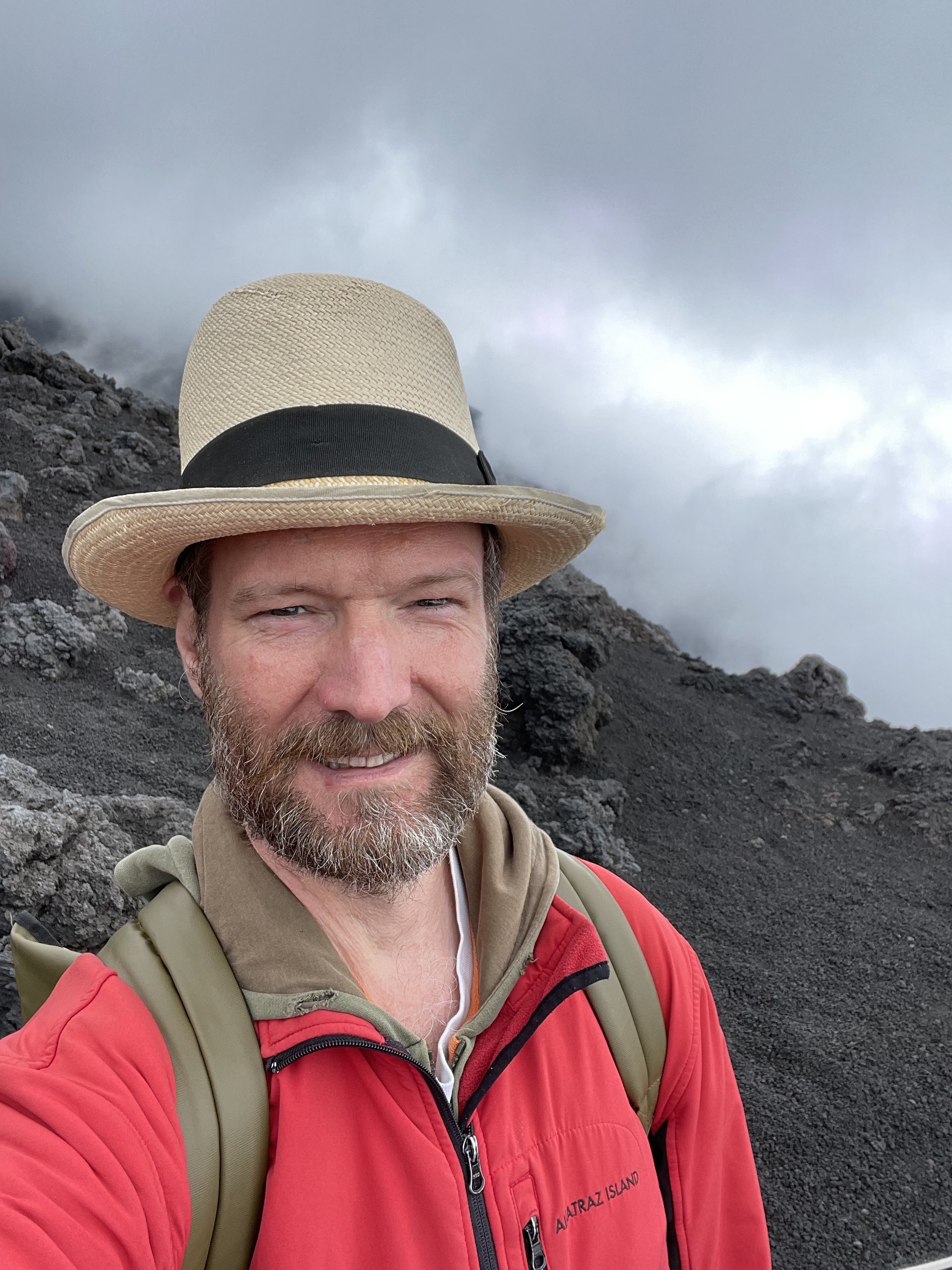
 I am still at the COMEX 7 conference, and enjoying the physics talks.  Yesterday (Wednesday) there was an afternoon off, with an optional excursion organised, taking willing attendees up to near the summit of Mt Etna.  Etna last had an eruption only a matter of a few weeks ago.  In fact, one of my colleagues, Jim Al-Khalili, told me he recently had a trip cancelled as all planes were stopped from flying into Catania airport because of the eruption.  I saw on the web that ash had fallen all over the city, including on the runway.  Well ... I trusted the tour guides to know whether it was safe for us to go up, and the excursion did go ahead.  It involved a pretty long coach journey up as far as it is possible to drive a coach, followed by a cable car trip up to a higher elevation, and finally a kind of bus-cum-moon-buggy to take us even closer to the top.

That 'closer to the top' was tantalisingly not quite up to the crater that erupts, but pretty close.  The ground was desolate and we were walking on ash that had only recently fallen there.  In fact, some of it had covered the winter snow fall, and we could see patches of snow just below the "soil".  The snow was protected from melting by the soil.  That was a bit weird.  It was pretty cool being up there, but kind of a shame not to see lava, or steaming vents, or a crater ... Here are some photos of the trip


Tuesday, 13 June 2023

At Comex7 in Catania

 I'm at the COMEX7 conference in Catania.  COMEX = collective motion in exotic nuclei, and the conference is mainly about giant resonances.  In fact the COMEX series follows an older series called "Giant Resonances" with the name change indicating a expansion of the topic to other collective motion.  Having said that, I don't think something like fission (a collective motion of nucleons) would be considered on topic while, in common to all conferences, there are plenty of (perfectly good and interesting) talks which are squarely off-topic. 

I travelled on Sunday, and the conference started yesterday.  As always happens at conferences I get reinvigorated with the excitement of the field; hearing the new results; getting ideas for ways I can contribute.  I'm here with my colleagues Abhishek and Esra, the latter of whom gave an excellent keynote talk yesterday:

My Surrey colleague Esra Yüksel talking at COMEX7

Catania is very pretty.  It is full of grand buildings though is also a bit run down and chaotic like big cities can be.  It feels like a big city when you are in the centre, though the official population is around 300k - so not so big, but the whole metro area is over a million.  

The conference is at the University in the outskirts of the city, and we have a conference bus taking us from the city centre where most delegates are staying.  I'm talking on Friday in the last session of the conference before heading off to the airport for the trip home.  Here is me last night with the city cathedral in the background

The author, and Catania cathedral


Thursday, 8 June 2023

Greggs vs Pret

 A nuclear physics colleague of mine – Robin Smith of Sheffield Hallam University – Tweeted a little while ago about a tongue-in-cheek (or oxtongue-in-bap) study he made of the relative density of Greggs Bakeries vs Pret-A-Manger sandwich shops, using machine learning to define the optimum line dividing England into a Greggs region, a.k.a. "The North", and a Pret region, a.k.a. "The South".  The study was then mentioned by a colleague of his at The Cheltenham Science Festival, and lo and behold the Daily Mail has picked it up.  Here's a tweet from yesterday by Robin with a link to the story, and the map.

It's been quite a while since any light-hearted studies I did were picked up for news coverage.  I hope Robin doesn't suffer too much ire from Daily Mail readers thinking scientists are spending research funding doing things like this when it is clear (even from the story in the Mail) that he did it all in his own time.  Now... what similar study could I do.  I think Waitrose vs Morrison has already been done.


Tuesday, 30 May 2023

Jim Jam

 On Friday we (School of Maths and Physics at Unversity of Surrey) hosted a celebration of the (still-ongoing) career of our colleague Jim Al-Khalili on the occasion of his 60th birthday.  There was a slightly more formal daytime conference with a series of talks by people who have worked with Jim over the years, either on academic things or on media and outreach activities.  I gave a short talk, going over the period of our work together where we started looking at proton tunnelling in nuclei - including on papers which announced the discovery of new isotopes (Re-159Ta-155, W-157 and Os-161), then moving on to more detailed work on tunnelling mechanisms in quantum mechanics which ultimately led to further developments on proton tunnelling in DNA, though I didn't talk about that much as I knew others were covering it.  

Following the more formal conference-like event, we ended the day with a more informal "In Conversation" in which Jim was interviewed by Roger Highfield, the author, journalist, and Science Museum director.  That gave the chance for audience members to ask questions, and ended with a round of "Happy Birthday".  I knew it was coming, so I was all set to record it on my phone.  Results are in the embedded tweet below


Tuesday, 23 May 2023

Strikes and Boycotts


 As I cycled home from dropping two of my kids off at school this morning, I stopped by a picket line outside the Royal Grammar School, a private boys' school in the centre of Guildford.  Teachers there are striking because the management are pushing through a withdrawal of staff from the teachers' pension scheme as they no longer want to pay the employer contributions.  Alongside this, they wish to "fire and re-hire" staff, moving them to worse contracts.  The striking staff understandably object to this, and have asked the management to negotiate, which I understand so far they have not been willing to do, and so this last resort of a strike is taking place.  

I was happy to stop and lend what words of support and encouragement I could.  One of my tasks today has been to fill in the form my employer asks me to fill in for those taking part in the legal industrial action currently happening in Universities.  The Marking and Assessment Boycott is not affecting my activities too much, as I don't teach in the spring semester.  However, I've been asked to do a small amount of marking and assessment related activity - amounting to something like one day of work.  I have refused, in accordance with the current industrial action, and now face being on half pay.  As with the union members following their own industrial action, so too the Universities are facing recommendations from UCEA to respond in a punitive manner and most are following through with that.

Friday, 19 May 2023

Skyrmions book


The amount of paper post that appears in my pigeon hole at work is a lot less than it used to be, but I still get paper copies of three professional magazines:  Physics World, CERN Courier, and Nuclear Physics News International.  I am also on the mailing list of the publisher World Scientific, as I succumbed to an offer from them some years ago and bought a little stash of discounted books.

They continue to send paper advertisements for new books, and I was interested to see one from the UK nuclear physics community appear in the latest Nuclear Physics mini cataloge.  It's called "Skyrmions: A Theory of Nuclei" and is by Prof Nicholas Manton FRS.  I can't say much about it as I don't have a copy, but the topic - the Skyrmion picture of nuclei, is an interesting one that I would like to learn about one day.  Probably when I am retired, if ever.   What I do know is that Skyrmions are topologically stable solutions to nonlinear field theories, and the solutions in the original Skyrmion model can be associated with different nuclei (while the theory is also now extended to non-nuclear systems).  It's a theory that is not widely known or used in the nuclear physics community, and has been kept alive since Skyrme's time by the mathematical physics community partly because it is a beautiful and satisfying theory that seems too good not to contain some truth in it.  Nicholas Manton has done a great job of taking the model to the nuclear physics community and showing how in detail it can actually describe real nuclei and related to the properties measured in the messy experiments that can seem far away from the abstract theories.

 From my work computer, I cannot see information about the book on the publisher's website because my desktop computer IP as seen by the external world is shared by many other computers in the Uni (probably all the desktops and the laptops connected by wifi).  As a result, World Scientific have blocked the IP address for "excessive usage".  Fortunately they do not block me from reading their paper-based flyers.