 |
Me (R), daughter (middle) and wife (L) attending the International Workshop on Nuclear Theory in Bulgaria in 2013
|
In the days before the pandemic I wasin the habit of keeping track of conferences coming up that I would potentially think about attending (or thought readers might). Since there are such things as conferences happening in the world again, then I figured I'd resume the tradition. I'll edit the post throughout the year as new things come up.
Since I now work on a combination of nuclear physics and quantum computing, I'm likely to post conferences about either of those areas, especially if I or a member of my group are actually going.
06/02/2023–11/02/2023: VI Topical Workshop on Modern Aspects in Nuclear Structure: "The Many Facets of Nuclear Structure", Bormio, Italy
A regular workshop organised by the nuclear physics group in Milan. A general conference where I am sure to find a welcome and some interesting topics. As I understand, the venue is also a ski resort, and there is ample time in the programme for skiing. This is not something that particularly attracts me, though I dare say I could get into it. In any case, no matter any other thoughts about it, the registration deadline has passed. [website]
04/04/2023–06/04/2023: IoP Nuclear Physics Conference, York, UK
This is the annual national conference organised by the IoP Nuclear Physics Group and the designated host University. We (Surrey) did it last year, and this year, the honour has fallen to York. As I rule I try to go to the IoP conference to meet up with the community, and support my students who are attending, and to get the latest news in nuclear physics research done in the UK, and the political news coming out of the STFC session that is usually included. This year, though, I've already booked a family holiday for these dates in the kids' Easter holidays. [website]
17/04/2023–19/04/2023: Quantum Computing Theory in Practice (QCTIP-2023), Cambridge, UK
This is an annual UK-based quantum computing conference which has a reasonable mix of computational scientists, mathematicians, and physicists, looking at anything from the very abstract to the very applied. I went last year (when it was in Bristol) and gave a poster about my student's work in using quantum computers to solve nuclear physics problems. I don't think I'll go this year, but will send one of my students along. [website]
08/05/2023–12/05/2023: Quantum-Classical Quantum Simulation (QCQS), Lausanne, Switzerland
A workshop on the use of quantum computers specifically as devices to simulate other quantum systems. This is the key aspect of a big chunk of my current work in trying to develop algorithms to be used on quantum computers to simulate / solve nuclear physics problems. [website]
22/05/2023–26/05/2023: Information and Statistics in Nuclear Experiment and Theory (ISNET-9), St Louis, USA
Part of series whose mission is to bring more sophisticated statistical analysis to nuclear physics, both in experiment and theory. I was involved in co-organising an earlier incarnation of the workshop, and have attended a few of them, though my actual research work on the topic is embarrasingly light. I'd like to attend, and feel a moral obligation to do so as part of the ISNET advisory board, but I am a little uncertain that I can justify the trip [website]
22/05/2023–26/05/2023: Advances and Challenges in Nuclear Fission and Quasi-Fission For the Superheavy Elements, Naples, Italy
A conference dedicated to understanding the reaction mechanisms during heavy ion fusion possibly leading towards complete fusion (i.e. the nuclei end up completely stuck), with understanding the competing mechanisms a necessary evil. One of my most recent publications was about this, and I'd be interested to go. [website]
21/05/2023–26/05/2023: 2023 CeNAM Frontiers in Nuclear Astrophysics Meeting, East Lansing, USA
CeNAM stands for Centre for Nuclear Astrophysics across Messengers. This looks to be a major new meeting, and the evolution of some previous major meetings on nuclear astrophysics under the JINA (Joint Institute for Nuclear Astrophysics) banner. [website]
04/06/2023–09/06/2023: Advances in Radioactive Isotope Science (ARIS), Avignon, France
This one covers a wide range of nuclear physics, with a particular bent towards what can be done using radioactive beams – in other words, at most of the big nuclear facilities. I have been to a precursor meeting in this series: ENAM (exotic nuclei and atomic masses) which merged with RNB (radioactive nuclear beams) some years ago to form the ARIS series. I'm sure I would find a lot here of interest, but since I will likely go to the COMEX conference later in June, I doubt I will make it to ARIS. [website]
09/06/2023–14/06/2023: PLATAN-2023, Jyväskylä, Finland
I'm not completely sure what PLATAN stands for, but it's described as a meeting between the Poznan meeting on Lasers and Trapping Devices in Atomic Nuclei Research and the International Conference on Laser Probing. In any case, I am going for the L standing for Lasers. I have worked a bit on the nuclear structure that is probed through laser spectroscopy and trapping, and visiting Finland and Jyväskylä is always a welcome pleasure, but this clashes with the COMEX conference which I have more current published work relating to, and is higher up on my list of conferences to attend.
11/06/2023–16/06/2023: Collective Motion in Nuclei under Extreme Conditions (COMEX7), Catania, Italy
This is very on-topic for me, through my interest in different kind of collective state explored using time-dependent calculations. I've been working on such stuff recently, which is poised for acceptence in a journal, judging by the latest (final, surely) referee report, and I think there's a good chance I will try to get to COMEX7 to present the work, if they accept my abstract. I've been at other COMEXes, most recently COMEX6 in 2018. [website]
25/06/2023–30/06/2023: International Conference on Proton-Emitting Nuclei (PROCON2023), Warsaw, Poland
Proton emission is an exotic form of radioactivity for nuclei very far from stability, with such an extreme proton to neutron ratio that they can decay by emitting protons. I don't think I've ever been to a PROCON, though I've worked on proton emission, and students of mine, and collaborators, have all gone. I have papers in PROCON proceedings, dating back to my PhD work which my supervisor presented at PROCON2003 in Legnaro (paper here), followed by several papers at the 2007 PROCON in Lisbon since at that time Jim Al-Khalili and I had a student working on proton emission in collaboration with experimentalists in Liverpool. Hence I am co-author on one discovery paper, for Re-159, a related paper looking at more details of the Re-159 discovery, and a theory paper snapshotting what the student was working on. I remain interested in proton emission (and tunneling phenomena in general) but haven't done much direct work on it recently, except learning a bit about instantons, though not enough to publish anything. [website]
02/07/2023–08/07/2023: International Workshop on Nuclear Theory (IWNT), Borovetz, Bulgaria
An annual meeting organised by the University of Sofia. It's a nice meeting out in the countryside south of Sofia. I've been there a few times before and always enjoyed it. It's usually one of the first meetings at the start of the University summer holidays (though before the school holidays). Before my now-9-year-old was of school age she came along to the conference one year - I think the only time my family has come along to a conference with me, which we then turned into a holiday in Sofia. It's certainly a nice one to go to, though a luxury to take that time away from other things that I don't think I can afford this year [website]
10/07/2023–12/07/2023: IReNA Workshop on Weak Interactions in Nuclear Astrophysics, East Lansing, USA
[website]
10/07/2023–14/07/2023: Chiral and Wobbling in Atomic Nuclei (CWAN'23), Huizhou, China
A conference on the unique kind of excited states that occur in triaxial nuclei through the lack of any kind of spatial symmetry. The existence of chiral bands and wobbling motion is usually deduced through gamma ray spectroscopy and the resulting information about energy levels. I have some track record in looking at giant resonances as a probe of triaxiality - something a bit different to what I think they are mainly intersted in, but I dare say on-topic enough. [website]
17/07/2023–23/07/2023: Capture Gamma Ray Spectroscopy (CGS17), Grenoble, France
CGS is a venerable series of conferences, originating in 1969. Now, the theme is broadly defined as gamma ray spectroscopy and anything suitably related to it, with the "capture" bit - where the gamma rays are instigated by e.g. neutron capture - somewhat redundant. I don't think I've ever been to a CGS conference before, but I do happen to have a set of the proceedings of CGS9 from when it was held in Bucharest in 1997. These are particularly useful, as they are two volumes contained in a wide slip case, and they form an excellent bookend on my shelves, being particularly hard to push over (see picture at end of post). If I remember correctly, I have them because one of my colleagues ended up with two copies, and thought I might like them. To be fair, conference proceedings are about the hardest things to source, should you ever need an article from one, and having a virtual library of them spread across different offices is a good idea. I have never attended a CGS, but I have at least one paper in the proceedings (of CGS13) when one of my Surrey colleagues presented work containing some calculations of mine. [website]
03/09/2023–08/09/2023: Position Sensitive Detectors 13, Oxford, UK
This touches on nuclear physics but covers any area where one might want to detect particles following a nuclear or atomic reaction or radioactive decay. There is nuclear representation there in the list of invited speakers [website]
11/09/2023–15/09/2023: Nuclear Photonics 2023, Durham, NC, USA
The word "photonics" is, I think, a relatively new coinage, meaning what devices one can make using of light (photons) as the medium, in analogy with electronics and electrons. In the case of nuclear photonics, the idea of "devices" is a bit far away, but the ability to undertake direct controlled interactions between nuclei and light pulses has advanced a lot over the years with facilities like HIγS in North Carolina and ELI–NP in Romania. I've co-authored some work with a PhD student based on work done at HIγS and could imagine myself getting a lot of this conference.
17/09/2023–22/09/2023: 20th International Conference on Ion Sources (ICIS'23), Victoria, BC, Canada
Organised by TRIUMF lab, who no doubt know all about ion sources - the first stage in producing the nuclei, at the centre of the ions, which are accelerated into beams for nuclear physics experiments. TRIUMF is one reportedly very nice place that I have never had an opporunity to visit, but ion sources are not something sufficiently up my street for this to be the occasion when I come to visit. [website]
18/09/2023–22/09/2023: XIth International Symposium on Nuclear Symmetry Energy (NuSym23), Darmstadt, Germany
The nuclear symmetry energy is a global property of nuclear matter which can be applied to nuclei and to objects such as neutron stars. As such, understanding it from a combination of theoretical and experimental methods is of interest to a broader range of scientists than just "nuclear physicists". My most-cited paper(s) are about such nuclear matter properties, and understanding how to link specific properties of individual nuclei with these kind of global properties has been an ongoing part of my research. A tempting conference! [website]
26/09/2023–30/09/2023: 29th Nuclear Physics Workshop, Kazimierz Dolny, Poland
A biennual (I think) conference, which I first (and last) attended 20 years ago. The nuclear group at Lublin does a good job of organising a regular small internation conference in this beautiful location on the Vistula river. Taking place in years when the Zakopane conference does not take place, it means that there is a good nuclear physics conference in Poland at least once each year. The Kazimierz Dolny one is smaller and bit more theory-orientated. Magda Zielinska corrected me on Twitter: The Kazimierz conference happens every year, while it is the Mazurian Lakes conference that alternates with Zakopane, therefore there are at least two good conference in Poland per year! [website]
19/11/2023–24/11/2023: FUSION23, Shizuoka, Japan
A delayed conference which was supposed to be called FUSION20 before it got cancelled in the Covid-19 pandemic. I had submitted an abstract for FUSION20 on work I had done looking at the effect of the surface energy on fusion properties [here]. I'll have to decide if I want to pick back up on that and finish the work to present it at the conference and then write up as a longer paper. As with COMEX, mentioned above, I've been to a few conferences in this series already, as it's a core part of my traditional nuclear physics research. [website]
27/11/2023–29/11/2023: WNCP2023, Osaka, Japan
A Workshop on nuclear cluster physics, dealing with anything to do with the idea that cluster structures exist inside nuclei. I've worked a little bit on clustering, and to me, it's a fun topic, as well as one which helps challenge our pictures of what really goes on inside a nucleus. I will wistfully think of Japan during this part of November, wondering if I should have gone to this and to FUSION23. [website]
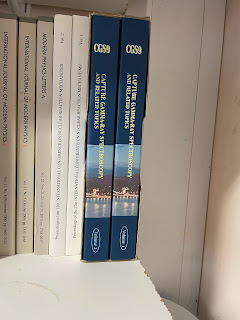 |
Proceedings of CGS9, at the end of my bookshelf
|



.jpeg)


