Wednesday, 23 September 2020

Science books of the year

 I saw yesterday that the Royal Society published their shortlist for their science books of the year.  There are 6 in the shortlist: The World According to Physics by Jim Al-Khalili, The Body by Bill Bryson, The Great Pretender by Susannah Cahalan, Explaining Humans by Camilla Peng, The Double X Economy by Linda Scott, and Transcendence by Gaia Vince.

Unusually, since I don't read a lot of popular science, I've actually read two of the books:  Transcendence and The World According to Physics.  They are both excellent, and would be worthy winners.  I got Transcendence for Christmas last year, and found its arguments compelling that humans' achievements are part and parcel of the way humans work together; the network of ideas, activities, language and culture evolve together with biological humans and have created a kind of super-organism.  Mind-blowing, well-researched and full of interesting anecdotes, I found myself wanting to tell people things I'd read in it as I was going through.  

The World According to Physics is right up my own subject area, so though I would expect to enjoy it, I wouldn't necesasrily prioritise adding a popular explanation of something I think I know well to my reading list, but I'm glad I did read it:  Sure, I knew most of the stuff already, but it was infused with such a joy for the wonder of the Universe, and our way of explaining it through physics, that I rekindled my own sense of awe at what I sometimes let lapse as part of my day-to-day activities.  I did even learn a few things, thanks to the inclusion of lots of very up-to-date and speculative ideas (which were flagged as such).  I should add that I read a draft of the book and gave some comments, and the author did hand me a copy once it was published.  Jim is my colleague at the Unviersity of Surrey.  No payment was received for this review ;-)


Wednesday, 16 September 2020

arxiv-vanity

 The document format pdf is pretty good when you want to make nice-looking output for printing for your scientific paper.  It's not always so handy when you want to read something on e.g. your phone screen, though, where you have to do a combination of zooming in and scrolling around to be able to read a paper.

A nicely-formated html version of a scientific paper, on the other hand, should be able to render nicely on a wider range of screens, and these days reading from screen has largely superseded reading from paper for me.  I read on Twitter about an arxiv-to-html translator called arxiv-vanity.  You give it an arxiv URL and it returns a nice readble web-page version of the paper you are interested in.  

I tried it on the recent whitepaper / review I was involved in writing on fission theory and the results are impressive.  Perhaps arxiv will fold it into its own offering soon.  


Friday, 11 September 2020

Update on the time-dependent methods special topic


 I last posted an update back in June about the Special Topic in Frontiers in Physics that I am co-editing.   Then, a new article on solitons in nuclear reactions had just been published.  This was actually followed a few days later with another paper, and then there has been a fallow period while the last few papers go through refereing, proofing, and publication.  Today, the next of those was published. so let me briefly mention the two new papers since June:

Marc Verriere and David Regnier have written a review on the time-dependent Generator Coordinate Method.  In fact, they discuss a number of related models which all share the character of mixing multiple Slater determinant wave functions to represent complex nuclear phenomena (reactions, fission) in which there is a significan change over time of the quantum state, and for which a time-dependent method is appropriate.  It's a nice contribution the Special Topic, covering one of the current hot methods in nuclear theory.  I can say this since I have a PhD student working on something that can be termed time-dependent Generator Coordinate Method, though it is not quite the same as the methods presented by Verriere and Regnier.  

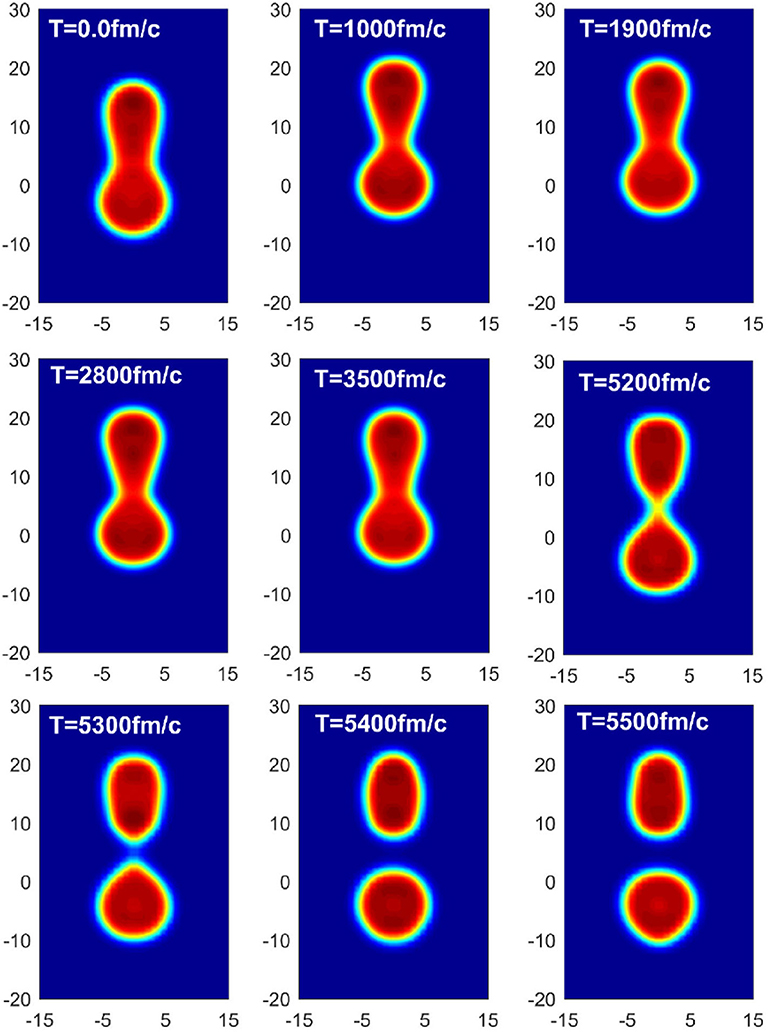
 The other paper, published today, is written by a University of Surrey undergradute student who took a year-long research placement at Peking University in Beijing, China.  He used time-depedent Hartree-Fock (TDHF) to look at the part of the fission pathway near scission where the TDHF method is applicable, and to study how different parameterisation of the nuclear force give different predictions for the pathway to fission.  It's a short piece of original research, which complements nicely the mix of other research and review articles in the Special Topic.  I worked on this project with Marko and his host supervisor, and am co-author on the paper.  I took the liberty of using a picture from this paper as an accompaniment to this blog post.

Once the two remamining papers appear,  on spontaneous fission and collective dynamics with a transport model, have appeared, the whole Special Topic will be avaiable as a free e-book, in pdf and epub format, so get your Kindles ready.


Friday, 7 August 2020

Deep Summer in Bishop's Stortford


It's a strange time right now, of course, with the Covid-19 pandemic ongoing.  I've been taking summer holiday in the form of working a couple of days per week and having more days off than on.  This week, I'm on holiday, and we have made a trip to visit my parents, following both our households isolating for an extended period.  I don't have a car, which is usually no problem, but we didn't fancy travelling by public transport right now, and fortunately my parents came to pick us up and bring us all up to their house, while my mother-in-law lent us her car, too, so that we could have the two-cars needed for the 6 of us.

So ... we have been carrying on the lifestyle of staying in and isolating from other people with the exception of my parents, at their house. It's nice spending so much time with them.  They've lived in this house for more than twenty years, and this two-week visit is the longest time I have continuously been here.  With 4 kids to play with and look after, there is no shortage of things to do, and my parents have (unlike us at home) subscriptions to the likes of Disney+ and Netflix.  

While I've been working just enough to keep up with MSc, PhD and undergraduate summer project students, a paper I worked on as part of a large supergroup of theorists to map out the next steps in understanding nuclear fission from a microscopic point of view was published.  It's a comprehensive (86 page!) paper bringing together expertise from a lot of different people to try to figure out how to move towards a unified theory of fission, a process which consists of many stages, operating a different timescales, with different degrees of freedom coming into play;  this calls out for a different range of approximations for each stage, and an understanding of how to link them together ideally with a single framework.  The paper is an attempt to put down all our ideas on how to proceed here.  I contributed what I could to those parts I felt sufficiently expert in, and the whole paper was put together by Prof Dobaczewski from the University of York.  It's available now, via its doi: 10.1088/1361-6471/abab4f, though it has not yet been assigned a page or article number.  Because there are UK-based co-authors, it is fully open-access, as is the case with all J Phys G papers with UK authors.

At the top is a picture of me photobombing my 8 month old son Kit, outside at my parents' house. 

Tuesday, 21 July 2020

A paper in IoP SciNotes on generating ion-ion potentials

I have had a paper published today in (new) journal IoP SciNotes.  It's on how to use the existing Sky3D code (written by a collaboration including me) with some small modifications to be able to do something it was not particularly designed for:  Generating the interaction potential between two nuclei.  The paper is referred to as P. D. Stevenson, IOP SciNotes 1, 025201 (2020).

This new journal, SciNotes, is supposed to be for research outputs which are perhaps not worthy of a full paper, but things that should nevertheless be out there.  Seemed like an appropriate place to document how to make a (very minor) tweak to a published code to do something new with it.  Here's a picture of the potential between two oxygen–16 nuclei made for the paper.

The method, by the way, uses an approximation called the Frozen Hartree-Fock approximation.  It may or may not be a brilliant approximation depending on your needs.  There are some references in the paper / note for further discussion of this points. 

This is the first single-author paper that is not a conference proceeding that I have published since 2003, I think.

Thursday, 2 July 2020

Margaret Burbridge Symposium

I received an email advertising a symposium celebrating the life and work of the late Eleanor Margaret Burbridge, pioneer of nuclear astrophysics.  The invitation to attend (online) is open, and I copy the email below with details of the event next week.  The image is a stylish representation of Prof Burbridge, from the linked-to website below:

Dear Colleagues,


Please join us on July 8th 2020 from 1:00-3:00 EDT for an online symposium to honor the late pioneer Eleanor Margaret Burbidge. The event will celebrate her life and science through short talks from her colleagues and collaborators as well as researchers who have benefited from her trailblazing and scientific insights.


Speakers include:


George Fuller  -  University California, San Diego

Anneila Sargent  -  California Institute of Technology 

Virginia Trimble  -  University California, Irvine

Fred Hamann  -  University California, Riverside

Vesa Junkkarinen  -  University California, San Diego

Amanda Karakas  -  Monash University

Artemis Spyrou  -  Michigan State University

Anna Frebel  -  Massachusetts Institute of Technology

Nicole Vassh  -  University of Notre Dame


The JINA-CEE website https://www.jinaweb.org/events/celebration-margaret-burbidge

can be consulted for any updates and viewing a commissioned illustration.


We encourage you to please share this email invitation with any colleagues, friends, or institutions that might be interested as the event is open to all.


We hope to see you there,


The Organizing Committee:

Frank Timmes, Arizona State University

Nicole Vassh, University of Notre Dame

Tuesday, 30 June 2020

Nuclear soliton review

The latest article in the special topic I am co-editing in Frontiers in Physics appeared today.  It is called "Solitons in Nuclear Time-Dependent Density Functional Theory" and is by Yoritaka Iwata, from Kansei University, Osaka.

It follows on from some of his previous work (including a paper in New Journal of Physics I co-authored with him), combining a review of why one might expect soliton behaviour in nuclei, some existing results, and a new more thorough exploration of relevant parameter space.

The basis of the idea is that the time-dependent density functional theory which describes nuclear systems appears as a non-linear Schrödinger equation which formally is equivalent to the canonical equation with which solitons are described.  Depending, then, on details of the nuclear interaction, and on the boundary conditions – the specific nuclear interaction being explored – one may find soliton solutions.

One particular confounding factor with the existence of solitons in nuclear reactions is the relative speed of the waves which equilibrate the charge and those which move matter.  If neutrons and protons are exchanged too quickly in reactions, then solitons are not possible.  This is something highlighted in Iwata's previous papers, and a hot topic in understanding heavy-ion reactions, with a recent paper in Physical Review Letters studying the same thing from a more nuclear physics (rather than mathematical/solitonic) perspective. 

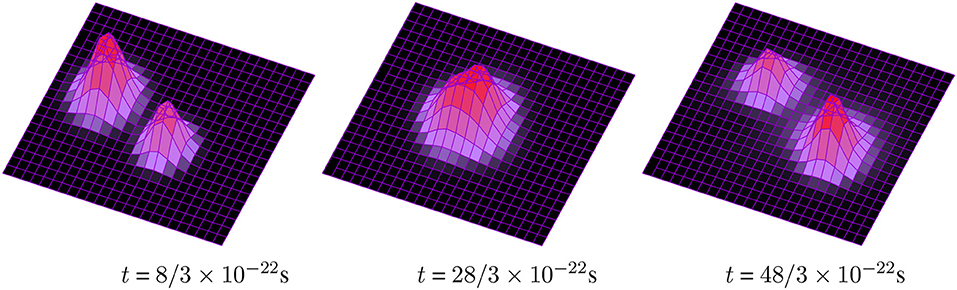
Here's a picture from the paper (their Figure 4) showing a collisions around the boundary where charge equilibration is important: