Friday, 7 August 2020

Deep Summer in Bishop's Stortford


It's a strange time right now, of course, with the Covid-19 pandemic ongoing.  I've been taking summer holiday in the form of working a couple of days per week and having more days off than on.  This week, I'm on holiday, and we have made a trip to visit my parents, following both our households isolating for an extended period.  I don't have a car, which is usually no problem, but we didn't fancy travelling by public transport right now, and fortunately my parents came to pick us up and bring us all up to their house, while my mother-in-law lent us her car, too, so that we could have the two-cars needed for the 6 of us.

So ... we have been carrying on the lifestyle of staying in and isolating from other people with the exception of my parents, at their house. It's nice spending so much time with them.  They've lived in this house for more than twenty years, and this two-week visit is the longest time I have continuously been here.  With 4 kids to play with and look after, there is no shortage of things to do, and my parents have (unlike us at home) subscriptions to the likes of Disney+ and Netflix.  

While I've been working just enough to keep up with MSc, PhD and undergraduate summer project students, a paper I worked on as part of a large supergroup of theorists to map out the next steps in understanding nuclear fission from a microscopic point of view was published.  It's a comprehensive (86 page!) paper bringing together expertise from a lot of different people to try to figure out how to move towards a unified theory of fission, a process which consists of many stages, operating a different timescales, with different degrees of freedom coming into play;  this calls out for a different range of approximations for each stage, and an understanding of how to link them together ideally with a single framework.  The paper is an attempt to put down all our ideas on how to proceed here.  I contributed what I could to those parts I felt sufficiently expert in, and the whole paper was put together by Prof Dobaczewski from the University of York.  It's available now, via its doi: 10.1088/1361-6471/abab4f, though it has not yet been assigned a page or article number.  Because there are UK-based co-authors, it is fully open-access, as is the case with all J Phys G papers with UK authors.

At the top is a picture of me photobombing my 8 month old son Kit, outside at my parents' house. 

Tuesday, 21 July 2020

A paper in IoP SciNotes on generating ion-ion potentials

I have had a paper published today in (new) journal IoP SciNotes.  It's on how to use the existing Sky3D code (written by a collaboration including me) with some small modifications to be able to do something it was not particularly designed for:  Generating the interaction potential between two nuclei.  The paper is referred to as P. D. Stevenson, IOP SciNotes 1, 025201 (2020).

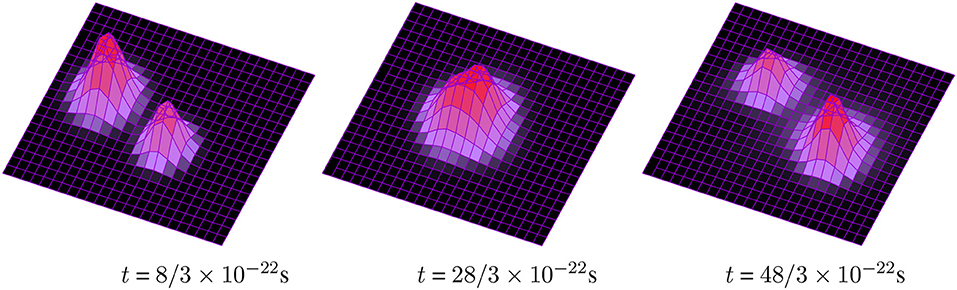
This new journal, SciNotes, is supposed to be for research outputs which are perhaps not worthy of a full paper, but things that should nevertheless be out there.  Seemed like an appropriate place to document how to make a (very minor) tweak to a published code to do something new with it.  Here's a picture of the potential between two oxygen–16 nuclei made for the paper.

The method, by the way, uses an approximation called the Frozen Hartree-Fock approximation.  It may or may not be a brilliant approximation depending on your needs.  There are some references in the paper / note for further discussion of this points. 

This is the first single-author paper that is not a conference proceeding that I have published since 2003, I think.

Thursday, 2 July 2020

Margaret Burbridge Symposium

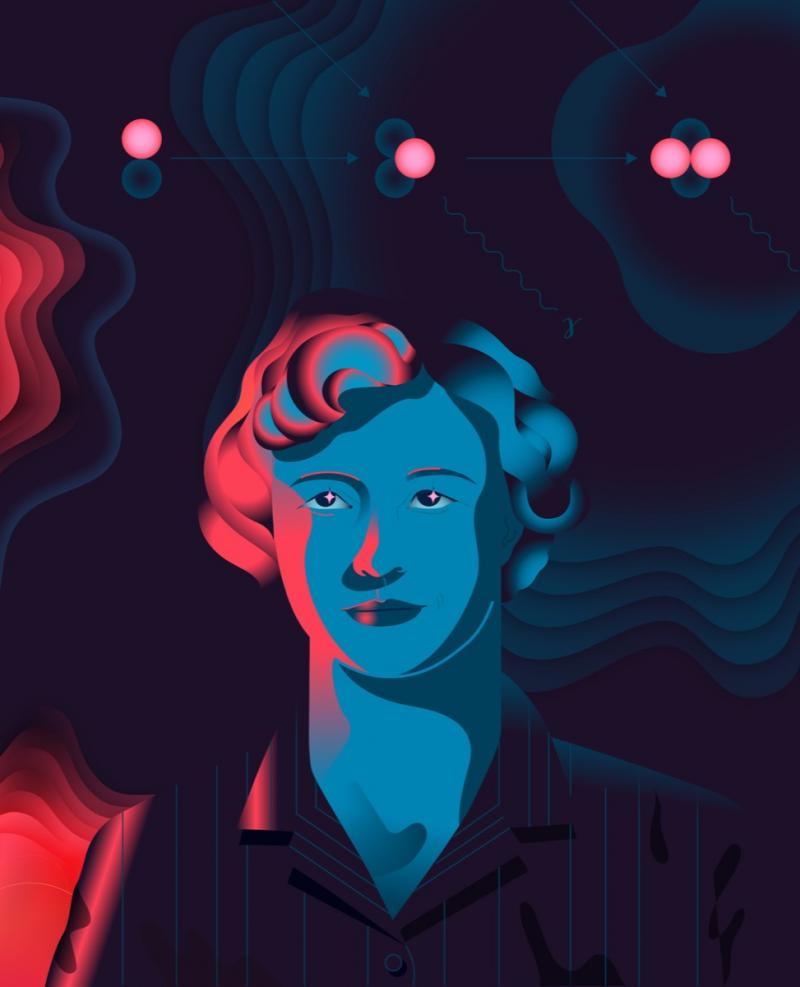
I received an email advertising a symposium celebrating the life and work of the late Eleanor Margaret Burbridge, pioneer of nuclear astrophysics.  The invitation to attend (online) is open, and I copy the email below with details of the event next week.  The image is a stylish representation of Prof Burbridge, from the linked-to website below:

Dear Colleagues,


Please join us on July 8th 2020 from 1:00-3:00 EDT for an online symposium to honor the late pioneer Eleanor Margaret Burbidge. The event will celebrate her life and science through short talks from her colleagues and collaborators as well as researchers who have benefited from her trailblazing and scientific insights.


Speakers include:


George Fuller  -  University California, San Diego

Anneila Sargent  -  California Institute of Technology 

Virginia Trimble  -  University California, Irvine

Fred Hamann  -  University California, Riverside

Vesa Junkkarinen  -  University California, San Diego

Amanda Karakas  -  Monash University

Artemis Spyrou  -  Michigan State University

Anna Frebel  -  Massachusetts Institute of Technology

Nicole Vassh  -  University of Notre Dame


The JINA-CEE website https://www.jinaweb.org/events/celebration-margaret-burbidge

can be consulted for any updates and viewing a commissioned illustration.


We encourage you to please share this email invitation with any colleagues, friends, or institutions that might be interested as the event is open to all.


We hope to see you there,


The Organizing Committee:

Frank Timmes, Arizona State University

Nicole Vassh, University of Notre Dame

Tuesday, 30 June 2020

Nuclear soliton review

The latest article in the special topic I am co-editing in Frontiers in Physics appeared today.  It is called "Solitons in Nuclear Time-Dependent Density Functional Theory" and is by Yoritaka Iwata, from Kansei University, Osaka.

It follows on from some of his previous work (including a paper in New Journal of Physics I co-authored with him), combining a review of why one might expect soliton behaviour in nuclei, some existing results, and a new more thorough exploration of relevant parameter space.

The basis of the idea is that the time-dependent density functional theory which describes nuclear systems appears as a non-linear Schrödinger equation which formally is equivalent to the canonical equation with which solitons are described.  Depending, then, on details of the nuclear interaction, and on the boundary conditions – the specific nuclear interaction being explored – one may find soliton solutions.

One particular confounding factor with the existence of solitons in nuclear reactions is the relative speed of the waves which equilibrate the charge and those which move matter.  If neutrons and protons are exchanged too quickly in reactions, then solitons are not possible.  This is something highlighted in Iwata's previous papers, and a hot topic in understanding heavy-ion reactions, with a recent paper in Physical Review Letters studying the same thing from a more nuclear physics (rather than mathematical/solitonic) perspective. 

Here's a picture from the paper (their Figure 4) showing a collisions around the boundary where charge equilibration is important:


Monday, 15 June 2020

The Surrey Alumnus and The Spy


Some nights, as I go to bed, if I am not falling asleep as my head hits the pillow, I pick up a book on the history of MI5, the British security service.  It's enjoyable bedtime reading, and a mighty tome which I am about 3/4 of the way through.  The book proceeds chronologically, and I'm currently around the 1970s.  This was perhaps a quieter time for spying than the days of the Profumo scandal or the Cambridge Five, at least in terms of international intrigue involving the Soviets, but I've just come across a spy that I had not heard of, that has some local interest to me.

Though I was an undergraduate at an Oxford college, I was never recruited as a spy, and if anyone tried, I totally misread it.  Now I have been at the University of Surrey for 20 years, it turns out that one of the ex-undergraduates here, from the earliest days of the University in the late '60s became a spy.  Michael John Smith studied electronic engineering at Surrey, and came to MI5s attention as someone who got involved in the activities of the Communist Party of Great Britain (CPGP).  He worked, after graduation, as an electronic engineer at EMI where he had clearance to work on technology contracts for Britain's nuclear bomb.  Apparently his security clearance was granted thanks to a mix-up in his rather common name, and the fact that there was another Michael John Smith enrolled in the Surrey branch of the CPGB.  He duly worked on radar fuses for Britain's free-falling nuclear bomb, and was able to pass documents on to the KGB.  Eventually, the clerical error at the security service was spotted, and his clearance was revoked.  His Soviet handlers had made sure he stopped taking the Morning Star, and switch to the Telegraph, join a local tennis club, and stop association with the CPGB;  still, they were suspicious that so soon after this preparation he was able to pass them such secrets, and they thought that the information about the radar-activated fuses, complete with details of the frequency used, and hence how to jam them, might have been fake plants from the British.  Not so. 

Eventually, Smith was arrested, and sentenced to 25 years in 1993, reduced to 20 on appeal.  I wonder where he is now.  Retired, and living round the corner from me, perhaps.  

The image at the top is from Britain's free-fall nuclear bomb WE.177, now at the Imperial War Museum North (presumably without the warhead inside).

Tuesday, 9 June 2020

Cycling near the speed of light in Nature

As mentioned in my last post, a paper written by a BSc project student and me has just appeared in Proc Roy Soc A, and was due to be mentioned in Nature.  Duly the Nature "research highlight" has appeared.

Here's a video the student made for the project (but which we did not include in the paper)


Friday, 5 June 2020

A paper on relativity, and a book on instantons: The week in Lockdown Guildford.

I've lost count of which week of lockdown it is, but I do know that it's Week 13 in the University calendar, which means two more weeks of semester to go and then it is the long vacation - or "the summer semester" depending how you reckon it.  I have two MSc projects to supervise over summer, so I have some direct teaching to do, as well as plenty of preparation for my autumn semester modules. 

This week I have been marking Final Year Project reports from various students on our BSc programmes, covering various different topics.  It's been interesting to see what they have been up to in their projects, and as marking goes, they are enjoyably varied – more so than 50 exam scripts answering the same questions, though the similarity in that case has its own benefits. 

This week also sees the publication (here) of a work done in a Final Year Project last year, by a student (Evan Cryer-Jenkins) working with me on a topic in Special Relativity - namely on the visual appearance of fast-moving objects.  There are well known optical distortion effects that arise in Special Relativity thanks to a combination of length contraction, and the finite speed of light meaning that light has to leave different parts of an extended object at different times in order to arrive at ones eye at the same time.  Evan, in this project looked at how such a distortion would appear to a two-eyed observer (or to two spatially-separated cameras) and how the two different images would not be able to be focused to a single image.  In a way it's similar to looking at an object through a glass of water - each eye will see a fixed shape distorted in to two different shapes because of the different optical path taken to reach each eye.  We also looked at what one might be able to infer (the distance and speed of the object) from the absolute and relative distortions.

We submitted the paper not much less than a year ago.  The first referee reports came back giving us hope for acceptance if we made a few changes, and responded to the referees' points.  The journal (Proceedings of the Royal Society) told us that a resubmission would be treated as a new submission, and so the published version is listed as being submitted in October.  They are also quite on the slow side at doing things at that journal, not helped by the Coronavirus situation.  Anyway - the paper was published this week.  The same day, a journalist from Nature got in touch asking about the paper in order to run a story on it.  That never happens to my nuclear physics research.

I also got, in the post, the fruits of my labour commenting on a book proposal for Cambridge University Press.  This was a book on instantons which can be used to describe quantum tunnelling processes.  I harbour a desire to use the technique to understand tunnelling in nuclear fission.  If, after some effort at understanding the book, and further effort with implementing the calculations, running the code, processing and understanding the output, I may be able to write that up and see it published for all to see.  I won't expect a journalist to get in touch with me, though.  Perhaps I should think more often of writing for such a general journal as Proc Roy Soc A.

The picture shows me reading the book about instantons.  Well, pretending to read, but activating the PhotoBooth app on my computer to take the picture.