Friday, 13 December 2019

A new parliament

I've been back at work from paternity leave for a week, and busy with marking and catching up on work bureaucracy, and my research group.  The big news hanging over everything has been the general election.  Ever since it was called several weeks ago I had supposed that it would not go well (for people of a progressive bent) since PM Johnson was leading the voices to call it and was doing so as he thought the timing was right to secure a Conservative victory, with the main opposition polling badly.  

And so it turned out to be. The campaigns proved to be rather dark and depressing.  In particular, things like the fake news being spread with absolutely no consequence, with the current Conservative Party (presumably led by the Machiavellian advisor Dominic Cummings) seemingly the worst offenders.  

This comes along with frightening anti-foreigner rhetoric with Johnson bemoaning that EU citizens in the UK had been treating it like their own home.  These are citizens who have come and made the country their home, and been welcomed.  

This, too, comes after Johnson threw moderate MPs out of his party, illegally suspended parliament, and made a series of ridiculous sloganistic promises he couldn't possibly deliver (I will deliver Brexit, do or die!) in the last parliament.  

The media have largely colluded with him, with attacks by the press on the judiciary, on parliament when it opposes the government.  This has all led, in my view, to a very extreme Conservative party, which has little bearing to Conservative parties of the recent past. God knows I was not much of a fan of those, but today's version has burnt up the rule book of even the pretence of fair play, and stoked up mass hatred and a them-and-us situation.  The word traitor is bandied about frequently.  Hacked Twitter posts threw doubt on a story of a boy sleeping on a floor in a hospital and BBC journalists hungrily lapped up the fake news, with inconsequential apologies after the damage was done.  Most reports begin "according to a government source" as the news media simply relays Cummings's proganda.

When Johnson first became PM, elected by the Conservative party then, not the general public, he announced without apparent irony that the mantra was to "Deliver Brexit, Unite the Country, and defeat Jeremy Corbyn". Clearly it is not possible to put as a top priority defeating the opposition while at the same time uniting the country, and he has been particualrly divisive.  Those Conservative MPs that sought to moderate him were simply expelled.  The Conservatives policies mean that the Brexit Party stood down candidates so as not to compete against them, and why not, when the Conservatives have absorbed much of what the Brexit party stand for.

So, today the results of the election are known and Boris Johnson remains our PM, and parliament reconvenes on Monday with a Conservative majority. 

The Conservative manifesto has been pretty light with promises (except the repeated mantra to Get Brexit Done), though they have promised to double research spending.   Of course, that is something that a research scientist might like the sound of, but so far I have only heard dismay amongst my colleagues about the election result, fearing that we all will pay a heavy price one way or another.  Of course, some of my colleagues, though not many, are right-leaning.  I don't know if they approve of the current form of the Conservative party or not... please comment below if so / not!

Johnson also specifically mentioned nuclear physicists when talking about who would be allowed to come into the country in future:   

He told Sky News: "People who, you know, are first violinists, nuclear physicists, prima ballerinas, whatever - they're going to come in, startup kings and queens, they're going to come in, simply by virtue of what they can contribute.

I don't suppose many nuclear physicists will want to come to Britain as entrepreneurs, but we'll see.

Well, that's my feelings today when everything appears darkest.  It will appear lightest to many, since after all this is what the vote of the population gave us.  Life will go on...

Friday, 22 November 2019

This is the Kit

This blog's quietude over the last month has been largely due to this being the time of year when my teaching and administrative duties are concentrated.  Not that this means I can't find the time to pass on some nuclear physics news, or more personal musings, via this blog, but I haven't done so.  Partly this is due to a kind of depression at the state of politics in the UK right now (which is a whole blog post in itself).  The other reason I've been preoccupied is trying to ensure I get everything I need to done before my son is born. It's not necessarily ever possible to "get everything done I need to" because there is always more stuff to do, but in any case, the arrival yesterday of a boy, Kit, means that I am going on paternity leave from Monday.  Here he is, being hugged by two of his his siblings, and with a bit of head support from mum:


Monday, 21 October 2019

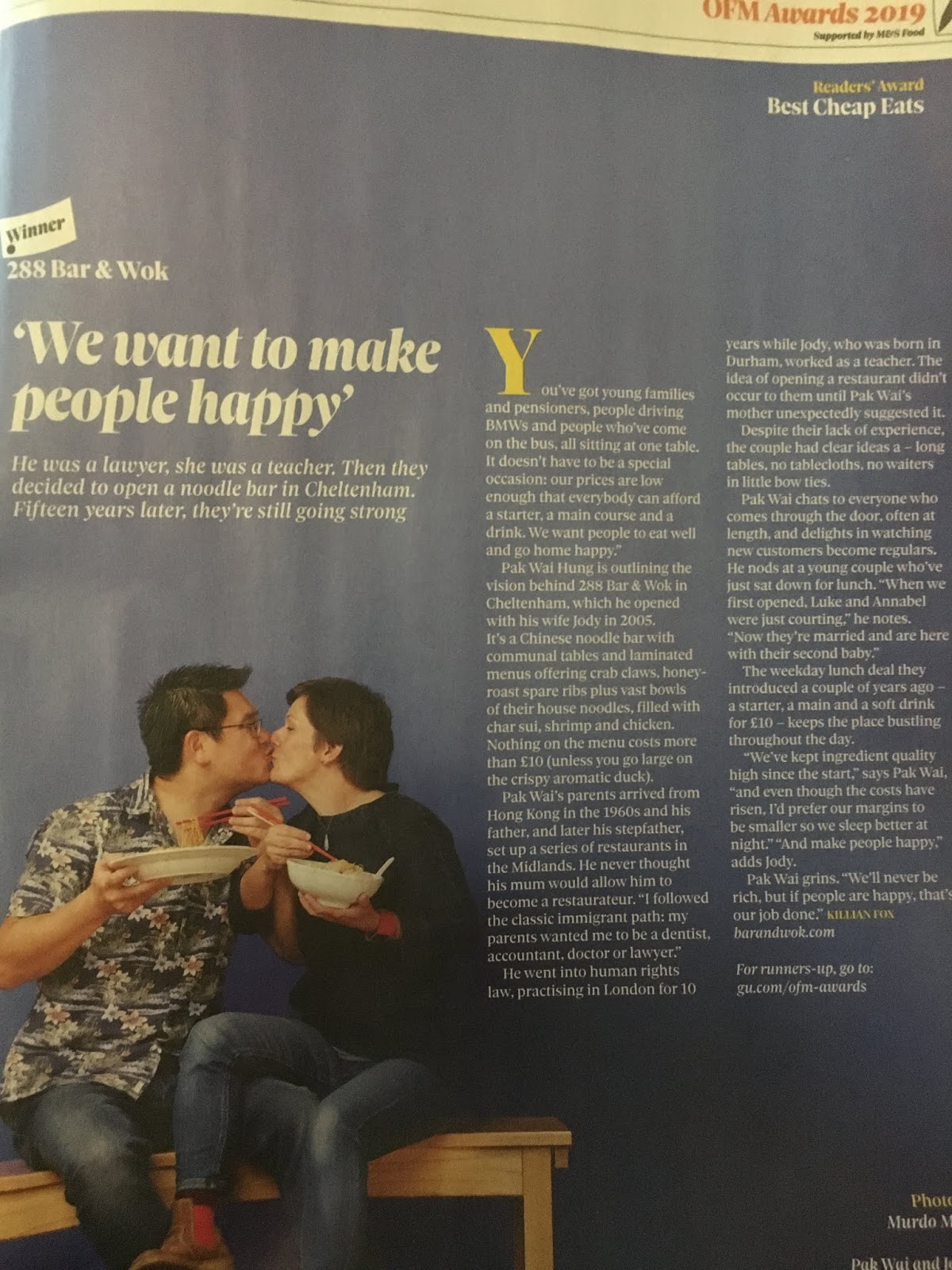
Prize-winning 288 Bar and Wok

I often buy the Observer on Sundays and usually don't read the Food Monthly magazine on those weeks when it appears.  Yesterday, however, I did open it to enjoy reading about the prize given to 288 Bar and Wok in Cheltenham in Observer Food Monthly's awards, in the category "Best Cheap Eats".  The owners, Jody and Pak Wai Hung are friends of mine, dating back to school days, where I first met Jody.  We haven't been brilliant at keeping in touch (story of my life) but we stayed with them a couple of years ago when we were in Cheltenham and had a lovely couple of days with them and their family.  And lots of great food.

One of the other winners of an award (in the category of Best Food Personality) is Jamie Oliver.  I half-knew Jamie from school.  He was in the year below me, and I certainly knew who he was, but I can't claim that we were friends.  I knew his wife Jools a bit better, as she came to my school in the sixth form (like Jody did - it was a boys school up to sixth form) and was then in the same year as me.  

It's a funny coincidence for a so-so state comprehensive school in Essex that I doubt very many people have picked up on, that it produced two winners in this years Observer Food Monthly awards.  Anyway, congratulations to Jody, Pak Wai, and Jamie.


Wednesday, 16 October 2019

Fission in York

Just had a busy and productive three days in York, attending a workshop in which we (the attendees) boldly have been trying to hash out the remaining problems in the theory of nuclear fission.  It's one of the most complicated processes that nuclei undergo, so the remaining problems in terms of a fully microscopic quantum theory are more or less "everything".

We will be producing a white paper as a statement of where we see the future of the field in due course, with a deadline for producing something in just a couple of weeks away to make sure we don't let the discussions be forgotten.  I excused myself from leading the coordiantion of part I am most involved in as I will be on paternity leave at an unspecified (but soon) future date.

York is a lovely city, and I didn't get to see much of it this time.  The meeting was in the King's Manor, an old mansion in the centre of town that now belongs to the University of York, and I stayed very close, between there and the Minster, so I did get a little bit of vicarious tourism in.  The picture is of King's Manor.  


Friday, 11 October 2019

The lithium-beryllium wars, continued

In May I posted about a public spat playing out on the arXiv between one member of a (former) collaboration, M. Gai of UConn, and other members, led by D Schumann of PSI.

My previous post was prompted by a lengthy note submitted to the arXiv by Gai (1905.06999) in response to a brief note by Schumann et al. (1904.03023v1).  

Earlier this week Schumann et al. superseded their note with version 2 (1904.03023v2), which is a substantially different document, going in to detail with an analysis of the history of the project and where they contend there are scientific errors.  Alongside this is some general statements about scientific research (e.g "It  is  the  dream  of  every  serious  researcher  to  contribute  with something  essential to the progress in  his/her  field  of  science.") as prelude to a continuation of the personal argument against Gai in terms of appropriate scientific and collaborative behaviour – so we may well see a response from Gai in due course. 

I find it tempting to read all this stuff slightly hiding my eyes behind my fingers, to avoid seeing things that make me cringe too much.  In the concluding section, Schumann writes "We have also to admit, that, making the entire quarrel public by posting comments and reply to comments further and further on, is not the way one should handle friction in a collaboration. These problems should have been solved internally before publishing anything."   Well, quite.

Friday, 4 October 2019

Proceedings of the EFB conference - open refereeing is go

I'm enjoying my temporary role as guest editor of the proceedings of the European Few Body Conference that we organised here at Surrey last month.  Because we are publishing the proceedings in SciPostProceedings, using their open refereeing model, the submitted papers are there for anyone to comment on. 

I'm expecting most of the submissions to be made closer to the deadline, but if you want to, feel free to look at the following and make comments online:

Roy Glauber and Asymptotic Diffraction Theory by Per Ostlund, is a mini review of one of Roy Glauber's achievements along with some biographical reminiscences.

Properties of heavy mesons at finite temperature by Gloria MontaƱa, Angels Ramos, and Laura Tolos, describes the authors' effective hadronic theory as applied to heavy (charmed) mesons

Study of deuteron-proton backward elastic scattering at intermediate energies by Nadezhda Ladygina discusses d-p elastic scattering using a relativistic multiple scattering framework, and

A time-dependent Hartree-Fock study of triple-alpha dynamics by P. D. Stevenson and J. L. Willerton uses a mean field dynamic approach to study the fusion of helium to form carbon.

If you feel qualified to comment on any of these, please go ahead.  They are all sent to a nominated referee, too, but open refereeing means that anyone can contribute. 

 The picture attached to this post is from the first paper listed, and shows Roy Glauber (winner of 2005 Nobel Prize in Physics) from the collection of the author of the proceeding article, Per Ostlund, as featured in the article.

Thursday, 3 October 2019

Dr Lennard-Jones

I was attending an appointment at the local hospital earlier this week, and one of the doctors present was called Dr Lennard-Jones.  I immediately thought of the Lennard-Jones potential, such a standard part of physics and chemistry that we teach it to our undergraduates, and named after Sir John Lennard-Jones (d.1954), who was a professor of physics at Bristol and Cambridge.

I wasn't sure if it was okay to ask if she (the doctor) was any relation, but during some small talk it came up what I did for a living, which was a way in for me to ask if she was any relation of the famous physicist.  The answer was yes, unsurprisingly (since presumably this particular combination of names has only been double-barrelled once).  If I remember what she said rightly, he was her great-grandfather.   She said it had been a while since anyone had asked and it was always nice when they did.  

I thought it was nice, too, to make that link, and to meet a real-life Lennard-Jones.  The picture is the famous 6-12 Lennard-Jones potential, courtesy of Wikipedia.