 |
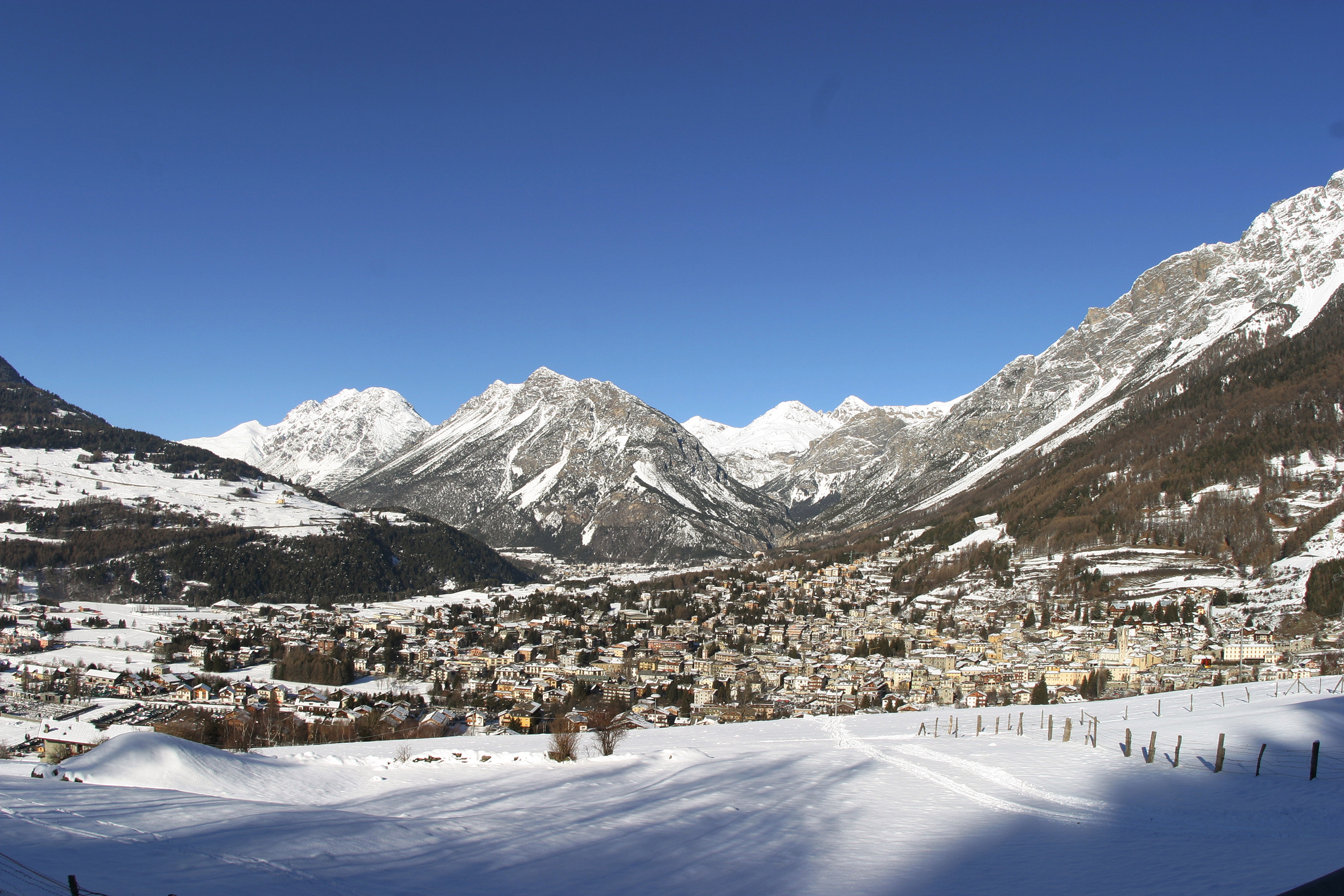
| Bormio: Location of meetings in Jan and Feb 2020 |
Here is a post, which I will add to over the next 18 months or so, listing (mostly low-energy) nuclear physics meetings taking place in 2020 that I hear about. Feel free to contact me or comment below with details of any that you think should be added
20/01–24/01: 58th Winter Meeting on Nuclear Physics, Bormio, Italy
It's blurb calls it a long-standing conference, and indeed at #58, it may hold a record for the most-held nuclear physics meeting. The remit is very broad, including what might once have been called nuclear physics, but is now particle physics. It is preceded by a one-day pre-conference school for students, covering the basics of the main physics areas dealt with in the conference.
Bormio is in the Italian Alps, and I understand that there is ample time in the programme for leisure activities, such as skiing. [website]
20/01–24/01: XIII LANSPA: Latin-American Symposium on Nuclear Physics and Applications, San José, Costa Rica
Aimed as a forum for groups in Latin America to share their research, the conference is nevertheless advertised more widely and open to anyone to attend. [website]
04/02–09/02: Vth Topical Workshop on Modern Aspects in Nuclear Structure, Bormio Italy
Subtitled "The many facets of nuclear structure" this workshop's aim is to explore topical issues in nuclear structure, bringing experimental and theoretical collaborators together. It's part of a series taking place every two years. This year, the meeting is preceeded by a one-day satellite meeting on 03/02 on Beta-decay studies: present and future campaigns [website]
24/02–28/02: Conference on Neutrino and Nuclear Physics (CNNP), Cape Town, South Africa
A conference for those working on the interaction between neutrinos and nuclei, whether it be for beta decay, reactor neutrino studies, dark matter searches, solar and supernova modelling and detector technologies. Or anything else closely related. This is the followup to a first CNNP meeting held in Catania in 2017 [website]
06/04–09/04: IoP Nuclear Physics Conferene, Edinburgh, Scotland
The annual UK Institute of Physics Nuclear Physics conference. Date announced, and further details to come, presumably. Update (Feb 2020): full details on [website]. Update CANCELLED DUE TO COVID-19
15/05–22/05: 13th International Spring Seminar on Nuclear Physics Perspectives and Challenges in Nuclear Structure after 70 Years of Shell Model, Ischia, Italy
A meeting organised by the theory group at the University of Naples, hosted on the island of Ischia. The topics are fairly broad, covering anything in low-energy nuclear structure. Should be good, and a lovely setting. [website]
20/05-22/05: 2020 JINA-CEE Frontiers in Nuclear Astrophysics Conference, South Bend, IN, USA
A save-the-date announcement has gone out (as of Dec 2019) about this conference, with more details to follow. Update (Feb 2020): here is the [website] Update POSTPONED DUE TO COVID-19
01/06–05/06: Nuclear Photonics 2020, Kurashiki, Japan
A conference on the emerging field of direct interaction and manipulation of nuclei with photons, coming about thanks to the new experimental sources of high-intensity lasers and monochromatic gamma rays. [website] Update POSTPONED UNTIL 7-11/06/2021 DUE TO COVID-19
11/06–15/06: IWND2020: International Workshop on Nuclear Dynamics in Heavy-Ion Reactions, Zhuhai, China
A recurring workshop on what one learns from heavy-ion reactions. Though an International workshop, it is China-based, focussing heavily on the research that takes place there. [website]
14/06–19/06: ARIS 2020, Avignon, France
ARIS stands for Advances on Radioactive Isotope Science (sic), and the conference series grew out of a combination of the earlier ENAM (Exotic Nuclei and Atomic Masses, I think) and RNB (Radioactive Nuclear Beams) conferences. It's quite a general, large conference for work coming out of radioactive beam facilities -- i.e. most of the big nuclear physics labs. [website] Update: Postponed to 05/09–10/09
29/06–03/07: DREB2020: Direct Reactions with Exotic Beams, Santiago de Compostella, Spain
A save-the-date email has been sent out for the latest in the series of DREB conferences. The first circular, with more details, has been promised in Sep 2019: Update (Feb 2020); here is the full [website]
22/06–26/06: CLUSTER'20: 12th International Conference on Clustering Aspects of Nuclear Structure and Dynamics, Dubna, Russia
For all things to do with the formation and existence of larger-than-nucleon substructures inside a nucleus. I have recently done some work on reactions leading to the Hoyle state, which can be described as a three-alpha cluster (see here) so may just find myself going along to this. Dubna is a nice place, though getting a Russian visa is a bit irksome. [website]
29/06–04/07: 10th Intl. Workshop on Quantum Phase Transitions in Nuclei and Many-body Systems, Dubrovnik, Croatia
"Quantum phase transitions" here means things like the change in shape or some other bulk property of a nucleus as a function of the number of particles with the emphasis being on the interpretation of such phenomena with the language and mathematics of phase transitions. I enjoyed going to a couple of the earlier outings in this series, but don't really feel connected enough to the field to justify attending any more, interesting though it would be [website] Update POSTPONED DUE TO COVID-19
05/07–11/07: IWNT39-2020: 39th International Workshop on Nuclear Theory, Rila Mountains, Bulgaria
A venerable annual meeting organised by the nuclear theory group in Sofia. I've been to a few of these in the past and have always enjoyed them for the rather relaxed environment with plenty of opportunity for discussion. A nice way to end the academic year with a visit here [website]
06/07-10/07: EXON-2020: International Symposium on Exotic Nuclei, St Petersburg, Russia
A conference on the production and study of the most exotic, far-from-stability nuclei across the period table from lightest to heaviest. Co-organised by labs around the world (JINR, RIKEN, GANIL, NSCL, GSI) [website]
26/07–31/07: Nuclear Structure 2020, Santa Cruz, CA, USA
Part of a series of conferences on nuclear structure run by US national labs. One of the first conferences I attended was one of these, organised by Oak Ridge National Lab in Tennessee when I worked there. This one is organised by Lawrence Berkeley National Lab, and held in Santa Cruz, a little south of the San Francisco bay area. [website]
19/08–23/08: APFB2020; Yamada Conference LXXII: The 8th Asia-Pacific Conference on Few-Body Problems in Physics, Kanazawa, Japan
This one was advertised to me at the European Few Body conference that I helped organise. I'm not typically a few-body person (more many-body) so my chance of going to this one are slim, unless the organisers get particularly wowed by the conference proceeding I produced for the European Few Body conference on the triple-alpha reaction [website]
30/08–06/09: 55th Zakopane Conference on Nuclear Physics, Zakopane, Poland
A regular conference taking place in Poland. The official theme is "extremes of the nuclear landscape" though it's really rather a general conference with talks covering a snapshot of current research in nuclear physics. I have never been to a Zakopane conference but I understand them to be enjoyable events, with good discussions of physics, and networking in a really nice-sized event (in a nice location, too). The circulars for this have come out when much of Europe is locked down due to the Covid-19 virus and they are currently (March 2020) planning to go ahead with organizing the conference [website]
31/08–04/09: CGS17: 17th International Symposium on Capture Gamma-Ray Spectroscopy and Related Topics, Grenoble, France
Capture gamma-ray spectroscopy marries capture reactions, in which a nucleus captures a projectile, with gamma ray spectroscopy to study the decay of the resulting compound system. This is a venerable series, dating back to the 1960s. Still an active area of research -- perhaps even more so than when it started thanks to the advent of radioactive ion beams [website]
31/08–04/09: PANIC 2020: Particles and Nuclei International Conference 2020, Lisbon, Portugal
A major conference taking place every three years which explores the interface between nuclear and particle physics. It covers a wide range of topics, from dark matter and cosmology, to applications of nuclear and particle physics technology, with everything experimental and theoretical inbetween. [website]
08/09–12/09: 7th IEA International workshop Clustering aspects in nuclei and reactions, São Paulo, Brazil
A workshop dedicated to the memory of Mahir Hussein, who died in 2019. [website]
13/09–19/09: Applied Nuclear Physics Conference 2020, Prague, Czechia
A new conference series being set up under the aegis of the European Physical Society Nuclear Physics Division. As per the title, the conference covers applications of nuclear physics, with a stated particular emphasis on "energy, health, space, security, environment, material science, preservation and study of cultural heritage". Abstract submission opening in December 2019 [website]
02/11-06/09: Shapes and Symmetries in Nuclei, Gif-sur-Yvette, France
A conference on experimental and theoretical work to determine the underlying shapes of nuclei and the symmetries that give rise to them. Part of a series, always held at Gif-sur-Yvette. I've not been to these before but it might be a good place to highlight my work on shape-induced mixing of giant resonances that I've been working on inspired by some experimental work from Osaka [website]
15/11–20/11: FUSION20, Shizuoka, Japan
A conference on heavy-ion fusion at energies near the Coulomb barrier. This topic is a mainstay of my research activities, so I expect to attend this one (as I did the previous outing of the conference in Hobart) [website]
24/11–27/11: International Worshop on Multi-facets of EOS and Clustering, Caen, France
An interesting slew of topics that are not often given co-prominence in a workshop (though of course all aspects of nuclear physics are part of a unified whole): "IWM-EC 2020 will focus on open questions in the domain of nuclear dynamics and thermodynamics, clustering phenomena and also the links between the nuclear Equation of state and Astrophysics." [website]
20/01–24/01: XIII LANSPA: Latin-American Symposium on Nuclear Physics and Applications, San José, Costa Rica
Aimed as a forum for groups in Latin America to share their research, the conference is nevertheless advertised more widely and open to anyone to attend. [website]
04/02–09/02: Vth Topical Workshop on Modern Aspects in Nuclear Structure, Bormio Italy
Subtitled "The many facets of nuclear structure" this workshop's aim is to explore topical issues in nuclear structure, bringing experimental and theoretical collaborators together. It's part of a series taking place every two years. This year, the meeting is preceeded by a one-day satellite meeting on 03/02 on Beta-decay studies: present and future campaigns [website]
24/02–28/02: Conference on Neutrino and Nuclear Physics (CNNP), Cape Town, South Africa
A conference for those working on the interaction between neutrinos and nuclei, whether it be for beta decay, reactor neutrino studies, dark matter searches, solar and supernova modelling and detector technologies. Or anything else closely related. This is the followup to a first CNNP meeting held in Catania in 2017 [website]
06/04–09/04: IoP Nuclear Physics Conferene, Edinburgh, Scotland
The annual UK Institute of Physics Nuclear Physics conference. Date announced, and further details to come, presumably. Update (Feb 2020): full details on [website]. Update CANCELLED DUE TO COVID-19
15/05–22/05: 13th International Spring Seminar on Nuclear Physics Perspectives and Challenges in Nuclear Structure after 70 Years of Shell Model, Ischia, Italy
A meeting organised by the theory group at the University of Naples, hosted on the island of Ischia. The topics are fairly broad, covering anything in low-energy nuclear structure. Should be good, and a lovely setting. [website]
20/05-22/05: 2020 JINA-CEE Frontiers in Nuclear Astrophysics Conference, South Bend, IN, USA
A save-the-date announcement has gone out (as of Dec 2019) about this conference, with more details to follow. Update (Feb 2020): here is the [website] Update POSTPONED DUE TO COVID-19
01/06–05/06: Nuclear Photonics 2020, Kurashiki, Japan
A conference on the emerging field of direct interaction and manipulation of nuclei with photons, coming about thanks to the new experimental sources of high-intensity lasers and monochromatic gamma rays. [website] Update POSTPONED UNTIL 7-11/06/2021 DUE TO COVID-19
11/06–15/06: IWND2020: International Workshop on Nuclear Dynamics in Heavy-Ion Reactions, Zhuhai, China
A recurring workshop on what one learns from heavy-ion reactions. Though an International workshop, it is China-based, focussing heavily on the research that takes place there. [website]
ARIS stands for Advances on Radioactive Isotope Science (sic), and the conference series grew out of a combination of the earlier ENAM (Exotic Nuclei and Atomic Masses, I think) and RNB (Radioactive Nuclear Beams) conferences. It's quite a general, large conference for work coming out of radioactive beam facilities -- i.e. most of the big nuclear physics labs. [website] Update: Postponed to 05/09–10/09
29/06–03/07: DREB2020: Direct Reactions with Exotic Beams, Santiago de Compostella, Spain
A save-the-date email has been sent out for the latest in the series of DREB conferences. The first circular, with more details, has been promised in Sep 2019: Update (Feb 2020); here is the full [website]
22/06–26/06: CLUSTER'20: 12th International Conference on Clustering Aspects of Nuclear Structure and Dynamics, Dubna, Russia
For all things to do with the formation and existence of larger-than-nucleon substructures inside a nucleus. I have recently done some work on reactions leading to the Hoyle state, which can be described as a three-alpha cluster (see here) so may just find myself going along to this. Dubna is a nice place, though getting a Russian visa is a bit irksome. [website]
29/06–04/07: 10th Intl. Workshop on Quantum Phase Transitions in Nuclei and Many-body Systems, Dubrovnik, Croatia
"Quantum phase transitions" here means things like the change in shape or some other bulk property of a nucleus as a function of the number of particles with the emphasis being on the interpretation of such phenomena with the language and mathematics of phase transitions. I enjoyed going to a couple of the earlier outings in this series, but don't really feel connected enough to the field to justify attending any more, interesting though it would be [website] Update POSTPONED DUE TO COVID-19
05/07–11/07: IWNT39-2020: 39th International Workshop on Nuclear Theory, Rila Mountains, Bulgaria
A venerable annual meeting organised by the nuclear theory group in Sofia. I've been to a few of these in the past and have always enjoyed them for the rather relaxed environment with plenty of opportunity for discussion. A nice way to end the academic year with a visit here [website]
06/07-10/07: EXON-2020: International Symposium on Exotic Nuclei, St Petersburg, Russia
A conference on the production and study of the most exotic, far-from-stability nuclei across the period table from lightest to heaviest. Co-organised by labs around the world (JINR, RIKEN, GANIL, NSCL, GSI) [website]
26/07–31/07: Nuclear Structure 2020, Santa Cruz, CA, USA
Part of a series of conferences on nuclear structure run by US national labs. One of the first conferences I attended was one of these, organised by Oak Ridge National Lab in Tennessee when I worked there. This one is organised by Lawrence Berkeley National Lab, and held in Santa Cruz, a little south of the San Francisco bay area. [website]
19/08–23/08: APFB2020; Yamada Conference LXXII: The 8th Asia-Pacific Conference on Few-Body Problems in Physics, Kanazawa, Japan
This one was advertised to me at the European Few Body conference that I helped organise. I'm not typically a few-body person (more many-body) so my chance of going to this one are slim, unless the organisers get particularly wowed by the conference proceeding I produced for the European Few Body conference on the triple-alpha reaction [website]
30/08–06/09: 55th Zakopane Conference on Nuclear Physics, Zakopane, Poland
A regular conference taking place in Poland. The official theme is "extremes of the nuclear landscape" though it's really rather a general conference with talks covering a snapshot of current research in nuclear physics. I have never been to a Zakopane conference but I understand them to be enjoyable events, with good discussions of physics, and networking in a really nice-sized event (in a nice location, too). The circulars for this have come out when much of Europe is locked down due to the Covid-19 virus and they are currently (March 2020) planning to go ahead with organizing the conference [website]
31/08–04/09: CGS17: 17th International Symposium on Capture Gamma-Ray Spectroscopy and Related Topics, Grenoble, France
Capture gamma-ray spectroscopy marries capture reactions, in which a nucleus captures a projectile, with gamma ray spectroscopy to study the decay of the resulting compound system. This is a venerable series, dating back to the 1960s. Still an active area of research -- perhaps even more so than when it started thanks to the advent of radioactive ion beams [website]
31/08–04/09: PANIC 2020: Particles and Nuclei International Conference 2020, Lisbon, Portugal
A major conference taking place every three years which explores the interface between nuclear and particle physics. It covers a wide range of topics, from dark matter and cosmology, to applications of nuclear and particle physics technology, with everything experimental and theoretical inbetween. [website]
08/09–12/09: 7th IEA International workshop Clustering aspects in nuclei and reactions, São Paulo, Brazil
A workshop dedicated to the memory of Mahir Hussein, who died in 2019. [website]
13/09–19/09: Applied Nuclear Physics Conference 2020, Prague, Czechia
A new conference series being set up under the aegis of the European Physical Society Nuclear Physics Division. As per the title, the conference covers applications of nuclear physics, with a stated particular emphasis on "energy, health, space, security, environment, material science, preservation and study of cultural heritage". Abstract submission opening in December 2019 [website]
02/11-06/09: Shapes and Symmetries in Nuclei, Gif-sur-Yvette, France
A conference on experimental and theoretical work to determine the underlying shapes of nuclei and the symmetries that give rise to them. Part of a series, always held at Gif-sur-Yvette. I've not been to these before but it might be a good place to highlight my work on shape-induced mixing of giant resonances that I've been working on inspired by some experimental work from Osaka [website]
15/11–20/11: FUSION20, Shizuoka, Japan
A conference on heavy-ion fusion at energies near the Coulomb barrier. This topic is a mainstay of my research activities, so I expect to attend this one (as I did the previous outing of the conference in Hobart) [website]
24/11–27/11: International Worshop on Multi-facets of EOS and Clustering, Caen, France
An interesting slew of topics that are not often given co-prominence in a workshop (though of course all aspects of nuclear physics are part of a unified whole): "IWM-EC 2020 will focus on open questions in the domain of nuclear dynamics and thermodynamics, clustering phenomena and also the links between the nuclear Equation of state and Astrophysics." [website]