Thursday, 20 September 2018

Self-citation record

I wonder what the record is for the number of times in one article that an author cites her or himself.  Here's a possible candidate:  Quantum Disentanglement as the Physics Behind Dark Energy, M. S. El Naschie, Open Journal of Microphysics 7, 1–30 (2017), which cites 249 other El Naschie papers.

The author, Mohamed El Naschie, has been the subject of much online discussion, as an editor of the journal Chaos, Solitons and Fractals, in which he published a sizeable minority of the total number of papers; papers which appear to be of little scientific worth.  They certainly make no sense to me. A Nature news story in 2008 about El Naschie, incited him to sue Nature.  He lost the case.  You can find more information on Peter Woit's blog here.

Anyway, I can't remember what made me stumble upon the paper above, but I recognised the author's name partly for the above infamy, but also because he has in the past quoted my University, the University of Surrey, as an affiliation in some published papers (e.g. this one), and those two things together make me notice when I see his name.  So I thought I'd look at this new paper.  I don't see myself ever citing the it, because it makes no sense to me, though I see that it has already been cited 4 times, by the following papers:

• M S El Naschie, The Looped Light of the Triple-Slit Real Experiment as a Confirmation for the Extra Dimensions of Quantum Spacetime and the Reality of Dark Energy, Optics and Photonics Journal 7, 19–26 (2017) doi:10.4236/opj.2017.72003
• M S El Naschie, The Quantum Triple-Slit Experiment and Dark Energy, Open Journal of Microphysics 7, 31–35 (2017) doi: 10.4236/ojm.2017.72002
• M S El Naschie, Spacetime from Zitterbewegung, Open Journal of Modelling and Simulation 5, 169–173 (2017) doi: 10.4236/ojmsi.2017.53012
• M S El Naschie, From a Dual Einstein-Kaluza Spacetime to ‘tHooft Renormalon and the Reality of Accelerated Cosmic Expansion, Journal of Modern Physics 8, 1319–1329 (2017) doi: 10.4236/jmp.2017.88085

Friday, 7 September 2018

The View from 1 Kemble Street

I'm at a funding council meeting today in London, on the 13th floor of a tower block at 1 Kemble Street.  From the window, I see the following view


It looks to me like I can see Guildford Cathedral on the horizon, as pointed to by the red arrow.  The University of Surrey nestles at its foot, in the direction of the view from where I am, though I can't obviously see it from here. 

Edit: As an astute reader pointed out in the comments, the blip on the horizon lies in the wrong direction to be Guildford, and is, perhaps, one of Croydon's tall buildings.

Wednesday, 5 September 2018

Women Scientists Who Made Nuclear Astrophysics

A paper entitled "Women Scientists Who Made Nuclear Astrophysics" has appeared on the nuclear theory section of the arXiv today.  It was originally posted a couple of weeks ago in the history of physics section.  The abstract sums up its purpose:

Female role models reduce the impact on women of stereotype threat, i.e., of being at risk of conforming to a negative stereotype about one's social, gender, or racial group. This can lead women scientists to underperform or to leave their scientific career because of negative stereotypes such as, not being as talented or as interested in science as men. Sadly, history rarely provides role models for women scientists; instead, it often renders these women invisible. In response to this situation, we present a selection of twelve outstanding women who helped to develop nuclear astrophysics.

The paper is destined for the proceedings of the conference Nuclei in the Cosmos XV.  The biographies of each of the scientists are very short, but give the interested reader enough to find out more.  

Nuclear astrophysics usually means those parts of science where nuclear physics and astrophysics intersect;  where the properties and reactions of nuclei apply themselves in stars.  It's a fluidly-defined sub-field, and it's not always clear from these brief biographies that they all fall in the intersection, but many of them lay foundations of one or other of the fields before the concept of "nuclear astrophysics" became a thing.  Anyway, it's a good read. 

The list of scientists are in order of date of birth, starting with Marie SkÅ‚odowska Curie.  The one member of the list who is still alive (at 99 years old) is Margaret Burbidge.  Here she is, in a picture from 1976


Wednesday, 29 August 2018

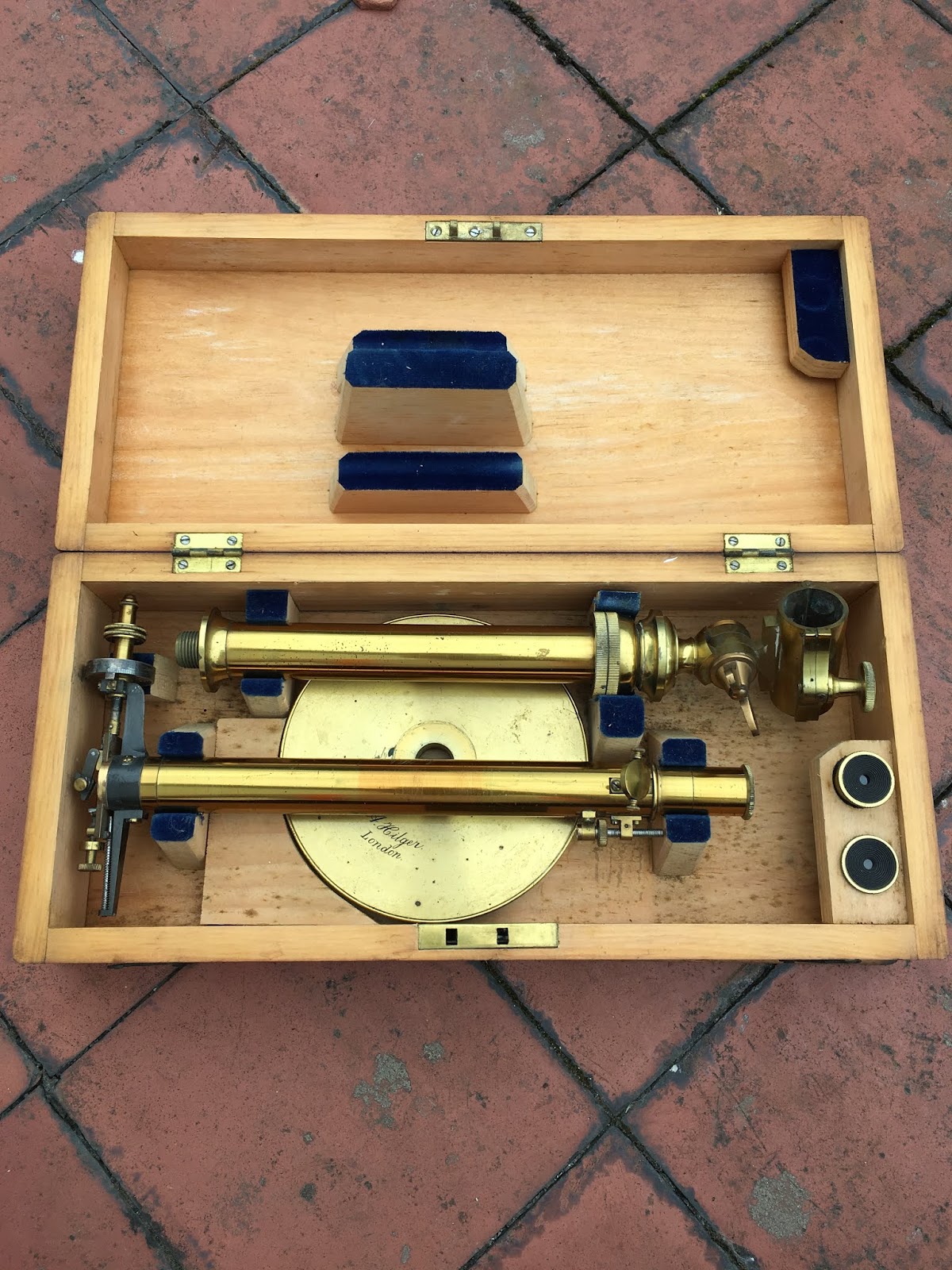
An old intrument of Lord Kelvin

I'm on a family holiday, staying in a house which belongs to a relative of Lord Kelvin, and which contains a box with the following note on the top:


The note reads "Does anyone know what this is?  A. Hilger was a late 19th century / early 20th  century instrument maker.  Beware: Box is in two parts (deliberately, I think)". 

Opening it up reveals the following.


It's reasonably obvious how to assemble it:  A post screws onto the base, and an optical instrument clamps into the top of that.  At one end is an eyepiece.  There are spare eyepieces in the box.


Near the eyepiece end there is a mirror to reflect some light down into it.


 At the end opposite the eyepiece end, there is a prism which swings round to the opening, and a calibrated screw to adjust the position of it.


Anyone have any ideas what it is and what it was used for?

Wednesday, 22 August 2018

Solar cell plagiarism

Here is an unfortunate case of plagiarism that has come to my attention via a nuclear physics colleague from Delhi on Facebook.

Here is the title and abstract of a paper published in Nature Energy (Konrad Domanski et al., Nature Energy 3, 61–67 (2018)) :

And here is the title and anstract of a paper published in Solar Energy Materials and Solar Cells (Zaeem Aslam et al., Solar Energy Materials and Solar Cells 185, 471–476 (2018)):

You might need to click on the pictures to be able to read the text, but the abstracts are both the same.  I understand the same is true for the full text, too, but I don't have access to the full papers.  I expect that the second paper (submitted 7th March 2018) will be retracted by the journal soon, leaving the first paper (published 1st Jan 2018) to stand. 

Friday, 17 August 2018

A-level grade boundaries

After the A–Level results are published, the exam boards release further details about the papers, including the grade boundaries.  Here is a document published yesterday from AQA, with such grade boundaries.  Scrolling down to the first physics paper gives fairly representative numbers.  In percentage terms, the scores needed for each grade are

A* 73%
A  60%
B  50%
C  40%
D  30%
E  20%

I don't think I knew these numbers before.  At Universities in the UK module pass marks are usually 40% (at least, I looked at a few at random: Southampton, Royal Holloway, Hull, and they all have 40%).  I dare say one has to demonstrate some real knowledge of the subject to hit even 20% of marks, so having a nominal pass outcome to show achievement at 20% seems reasonable enough.  Interesting!  70% seems to be a pretty standard University score for a first class degree (see p6 of the Southampton document, above), so actually, the A–Level and Unviersity schemes seem pretty will lined-up, except that a C grade at A–Level would be about the lowest grade to consider accepting without any other indicators to go on.

Thursday, 16 August 2018

Flowers in the Office

Here is my hot tip for improving your working environment:  Buy (or grow) some flowers for yourself and put them in the office.  They always lift my mood, and cause people to ask me if I have an admirer (I don't).  It's especially useful if, like me, there is no plant life to be seen from your office window, especially since they have got rid of the moss on top of the bicycle sheds