Wednesday, 29 August 2018

An old intrument of Lord Kelvin

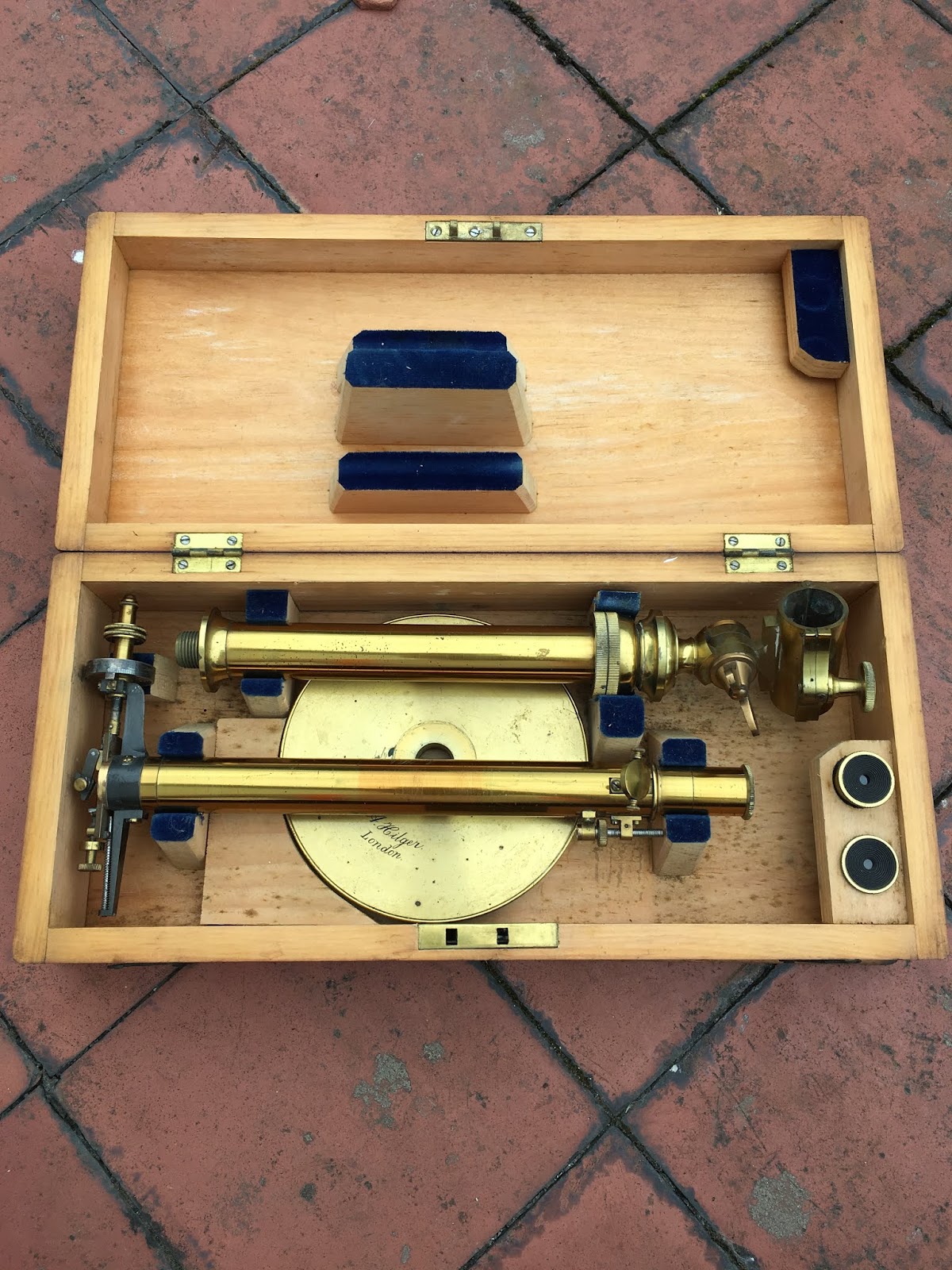
I'm on a family holiday, staying in a house which belongs to a relative of Lord Kelvin, and which contains a box with the following note on the top:


The note reads "Does anyone know what this is?  A. Hilger was a late 19th century / early 20th  century instrument maker.  Beware: Box is in two parts (deliberately, I think)". 

Opening it up reveals the following.


It's reasonably obvious how to assemble it:  A post screws onto the base, and an optical instrument clamps into the top of that.  At one end is an eyepiece.  There are spare eyepieces in the box.


Near the eyepiece end there is a mirror to reflect some light down into it.


 At the end opposite the eyepiece end, there is a prism which swings round to the opening, and a calibrated screw to adjust the position of it.


Anyone have any ideas what it is and what it was used for?

Wednesday, 22 August 2018

Solar cell plagiarism

Here is an unfortunate case of plagiarism that has come to my attention via a nuclear physics colleague from Delhi on Facebook.

Here is the title and abstract of a paper published in Nature Energy (Konrad Domanski et al., Nature Energy 3, 61–67 (2018)) :

And here is the title and anstract of a paper published in Solar Energy Materials and Solar Cells (Zaeem Aslam et al., Solar Energy Materials and Solar Cells 185, 471–476 (2018)):

You might need to click on the pictures to be able to read the text, but the abstracts are both the same.  I understand the same is true for the full text, too, but I don't have access to the full papers.  I expect that the second paper (submitted 7th March 2018) will be retracted by the journal soon, leaving the first paper (published 1st Jan 2018) to stand. 

Friday, 17 August 2018

A-level grade boundaries

After the A–Level results are published, the exam boards release further details about the papers, including the grade boundaries.  Here is a document published yesterday from AQA, with such grade boundaries.  Scrolling down to the first physics paper gives fairly representative numbers.  In percentage terms, the scores needed for each grade are

A* 73%
A  60%
B  50%
C  40%
D  30%
E  20%

I don't think I knew these numbers before.  At Universities in the UK module pass marks are usually 40% (at least, I looked at a few at random: Southampton, Royal Holloway, Hull, and they all have 40%).  I dare say one has to demonstrate some real knowledge of the subject to hit even 20% of marks, so having a nominal pass outcome to show achievement at 20% seems reasonable enough.  Interesting!  70% seems to be a pretty standard University score for a first class degree (see p6 of the Southampton document, above), so actually, the A–Level and Unviersity schemes seem pretty will lined-up, except that a C grade at A–Level would be about the lowest grade to consider accepting without any other indicators to go on.

Thursday, 16 August 2018

Flowers in the Office

Here is my hot tip for improving your working environment:  Buy (or grow) some flowers for yourself and put them in the office.  They always lift my mood, and cause people to ask me if I have an admirer (I don't).  It's especially useful if, like me, there is no plant life to be seen from your office window, especially since they have got rid of the moss on top of the bicycle sheds


Friday, 27 July 2018

Bypassing the paywall, legally

I've recently come across unpaywall, a web browser plug-in that spots when you are looking at the abstract of an academic article on a scholarly journal's website and adds in a link to a free version of the article, if one is available legally somewhere online. 

Many if not all journals which publish academic articles (and charge for them) allow authors to put copies of the articles (perhaps in some pre-publication format) up on their own websites or on institutional repositories.  At the University of Surrey, we have such a repository, and I thought I'd check to see if unpaywall will pick up articles that we've put there.

So, picking not quite at random an article of mine which is available free from our institutional repository here, I go to the Nuclear Physics A page where my article is published

Lo, with the unpaywall plug-in installed, I see a little green unlocked padlock logo on the right of the page, that is not usually there:


If I click on the logo, I get a pdf copy of my paper from the Surrey ePubs website.  This is handy!  For me, it will be most useful while travelling, since in my office I can download the journal articles through my institution's subscription for journals where they have one, which is most of the journals where I publish.  This is automatically detected through my computer's University IP address.  On the road, I have to rely on some sometimes clumsy methods of getting the University subscription recognised on a per-journal basis.   

Of course, it only works if there is a legal and free version of the paper somewhere online, and unpaywall has found it,  but I'll keep it installed.  The only downside I can see is that it doesn't work on the default browser on the Mac, Safari, so I'll have to switch to Firefox or Chrome.  That's a drag, but I'm not a browser zealot.  I save that for Emacs.

Wednesday, 11 July 2018

The great Google Citation Purge

Our Vice-Provost for Research and Innovation writes a blog to share thoughts, ideas, and announcements.  I thoroughly approve of his communicating via a blog, of course.  I end up reading what he says more than some other communications from the top that get put on e.g. the University's intranet.  It's a shame that the blog does not allow commenting, as that's an integral part of the ethos and culture of blogs, in my opinion, but okay, it's perhaps not surprising from a blog on a corporately-controlled part of the University website.  At least the thing exists.

Recently, he wrote a pretty extensive post about sharing and advertising one's research.  It is aimed at University of Surrey staff, and so is partly dedicated to our own institutional repository, but its chief recommendation is to use Google Scholar.  I do, and I've been using it for many years.  I posted in 2012 about an annoyance of Google Scholar in that it sometimes seems to forget about citations that it previously knew about.   It has just undergone a such a moment of amnesia.

My most cited paper, as previously judged by Google Scholar is this one.  As I write this post, the commercial subscription citation database ISI Web of Knowledge thinks it's been cited 216 times (making it #3 of all the Phys. Rev. C papers from 2012).  It even has a little trophy logo, calling it a "Highly Cited Paper":


Google Scholar was recently completely on board with this, listing it as my most highly cited paper, but I can't show you a screenshot because it now thinks it is more modestly-cited, at a mere 33 citations:


Based on my past experience, Google Scholar usually knows of many more sources of citation than ISI -- from PhD theses, for example, if they have been posted anywhere online, yet suddenly the number of citations has dropped rapidly.

Anyone know why?

Thursday, 28 June 2018

Decisions, decisions

My old office chair has broken.  Part of the process of getting a new one is to pick a colour for the fabric.  I was sent the attached swatch chart


What a dilemma!  I wasn't even aware that some of these were names of colours.  One of my colleagues commented on the existence of the colour Hobbit while another urged Wine upon me.  In the end I went for Trident, being a good nuclear physicist.  I could have gone for Cobalt, it being an element, but it's got an odd atomic number (Z=27), so I tend to avoid it.