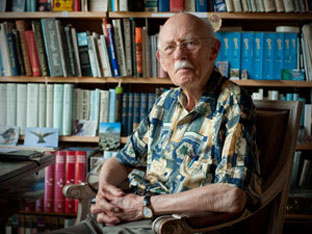
Today the Royal Society announced the appointment of its 2016 intake of Fellows (who don't have to be fellows). The announcement is here. I can't claim to be familiar with many of them, but for the topic of this blog, it's noteworthy that the nuclear engineer Sue Ion is now (Dame) Sue Ion FRS. A few years ago she was tasked with writing a report about the state of nuclear science in the UK and I think she did a good job in highlighting the parlous state of the support given by the funding councils to nuclear physics in particular (I blogged about it back in 2010) So, congratulations Sue, along with the other 49 new Fellows. That's Sue in the picture associated with this post, courtesy of the Royal Society website.
All about nuclear physics - research, news and comment. The author is Prof Paul Stevenson - a researcher in nuclear physics in the UK. Sometimes the posts are a little tangential to nuclear physics.
Friday, 29 April 2016
Wednesday, 27 April 2016
Sir Denys Wilkinson FRS 1922–2016
I heard the news yesterday that Sir Denys Wilkinson died on 22nd April 2016, aged 93. I can't (since I'm not qualified to) give much of a general obituary here. They will presumably appear elsewhere in due course, written by those that knew him personally. Though I met him once or twice at conferences when I was a graduate student, I know Denys more as one of the big names in UK nuclear physics, as well as through his rising up the ranks of research and higher education administration. He was vice-chancellor of the University of Sussex between 1976 and 1987. Preceding that, he was professor at the University of Oxford, and the building that used to be called the Nuclear and Particle Physics building during my time there is now called the Denys Wilkinson Building.
Though I don't suppose he was very active at the Royal Society in recent years, he was a Fellow there, and one of the last remaining fellows whose science background was in nuclear physics.
Friday, 8 April 2016
Spot The Difference #6
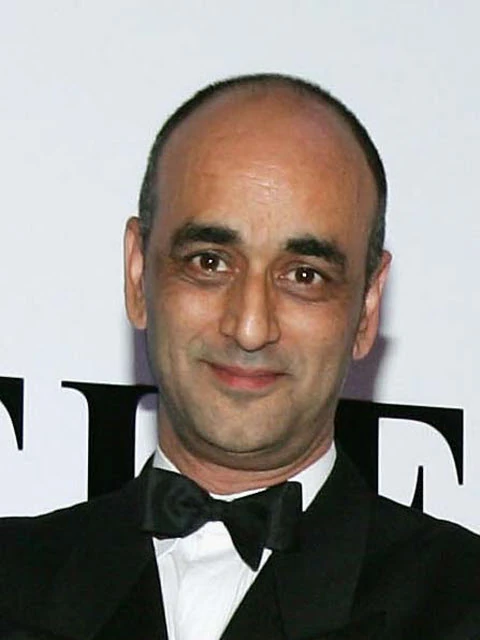
I wonder if readers have ever noticed the similarity between University of Surrey physicist Jim Al-Khalili and Holby City physician Art Malik?
|
![]() | |
Al-Khalili
|
Malik
|
Thursday, 7 April 2016
The kids here still respect the college dean
A friend of mine posted a video of Merle Haggard singing Okie From Muskogee yesterday, on Twitter. I like the song, and I even once sang it at karaoke when an undergraduate, as I remember. Only later did I realise that the Twitter post was occasioned by Merle Haggard's death. Great song, Merle. RIP.
Tuesday, 22 March 2016
Signed Refrigerators
In the coffee room of the nuclear physics building here at ANU, there is a tradition that when staff leave, they host a leaving party, filling the refrigerator up with beer, thereby earning the right to sign the fridge door. The tradition has been going on so long that the oldest fridge door is now mounted for display on the wall. If you click on the picture you can see an enlarged version, with names and dates.
Monday, 21 March 2016
How to spot a nuclear physics building
I'm visiting a student on placement in Canberra today. I've not been to Australia before, but the nuclear physics building at the Australian National University looks much like a nuclear physics building elsewhere. At least, as long as there is a tandem accelerator which needs to be housed. It's a useful landmark to help navigate to the building.
I was given a guided tour by our student Jess and one of her local supervisors, Ed, who also happens to have once been one of our placements students, some years ago (albeit in the US). In the picture is me, with Jess (photo taken by Ed). There's also a picture there taken down the beam line, looking quite high-tech.
Of the things I've noticed so far, the brightness of the light is conspicuous. I'm used to living about 15ยบ further away from the equator than this, and it does make a difference to how bright the light is in the day, and how it lights up the scenery. Also, my body has noticed the eleven hour time difference, which is a little bit gruelling.
Thursday, 17 March 2016
Jobs at Surrey
I'm pleased to be able to announce that we, at the University of Surrey, have two permanent positions available in the Physics Department: One in theoretical nuclear physics, and one in experimental nuclear physics. The jobs will appear online at http://jobs.surrey.ac.uk/ probably on Monday (edit: It is at https://jobs.surrey.ac.uk/vacancy.aspx?ref=019816). For now, here is the text that will appear in the advert. Please circulate widely!
University
of Surrey
FACULTY
OF ENGINEERING AND PHYSICAL SCIENCES
Department
of Physics
Lecturer
in Experimental Nuclear Physics
Lecturer/Senior
Lecturer in Theoretical Nuclear Physics
Salary
from £38,896 - £57,047 per annum (subject to experience and qualifications)
The
Department of Physics is seeking to strengthen its successful scientific
programme by appointing two new academic posts in Experimental and Theoretical
Nuclear Physics. This exciting new initiative ties in with the emergence of the
next generation of radioactive beam facilities such as FAIR, FRIB, HIE-ISOLDE
and RIKEN that offer a host of fresh opportunities across the field of nuclear
physics. In particular, Surrey is committed to seizing the new experimental
opportunities relating to nuclear structure and nuclear astrophysics research
and providing leadership in theoretical understanding, including innovative
developments in nuclear reaction theory.
The
Surrey Nuclear Physics Group is strongly engaged in research internationally
and has a long-standing reputation as a world-leader in the field. The Group
leads experimental projects at a wide range of facilities spanning the areas of
spectroscopy, transfer reactions and nuclear astrophysics. Theoretical research
at Surrey is at the frontiers of reaction theory, ab initio calculations,
mean-field calculations and the theory of nuclear matter. Most recently, close
links with the UK’s National Physical Laboratory have allowed the Group to
extend the scope of its research in radiation sensing and radionuclide
metrology. The two new academic staff members will be expected to develop
independent research profiles that complement and extend current research
strengths and activities, and are aligned with the overall scientific goals of
the Group. As part of the written application, candidates should submit a brief
research proposal (maximum 2 pages) that describes a vision for their research
programme, highlighting both initial interests and possible longer-term aims. Alongside
their research activities, the successful applicants will join an enthusiastic
team of physics academics with a commitment to excellence in undergraduate and
postgraduate teaching.
For
general information about academic posts in the Department of Physics
applicants should address queries to Professor Stephen Sweeney, Head of
Department (s.sweeney@surrey.ac.uk).
Informal enquiries regarding the experimental nuclear physics position should
be addressed to Prof. Wilton Catford (w.catford@surrey.ac.uk),
while enquiries regarding the theory position can be addressed to Dr. Paul
Stevenson (p.stevenson@surrey.ac.uk).
All enquiries will be handled strictly in confidence. For further information
about the Department of Physics at Surrey visit www.surrey.ac.uk/physics. Please direct questions related to the
application procedure to Ms Kate Sheen (k.sheen@surrey.ac.uk,
tel: +44 (0)1483 686126). Reference letters will only be requested of shortlisted
candidates. For further information about the University of Surrey, please
visit www.surrey.ac.uk.
We acknowledge, understand and embrace cultural diversity.
Subscribe to:
Posts (Atom)